
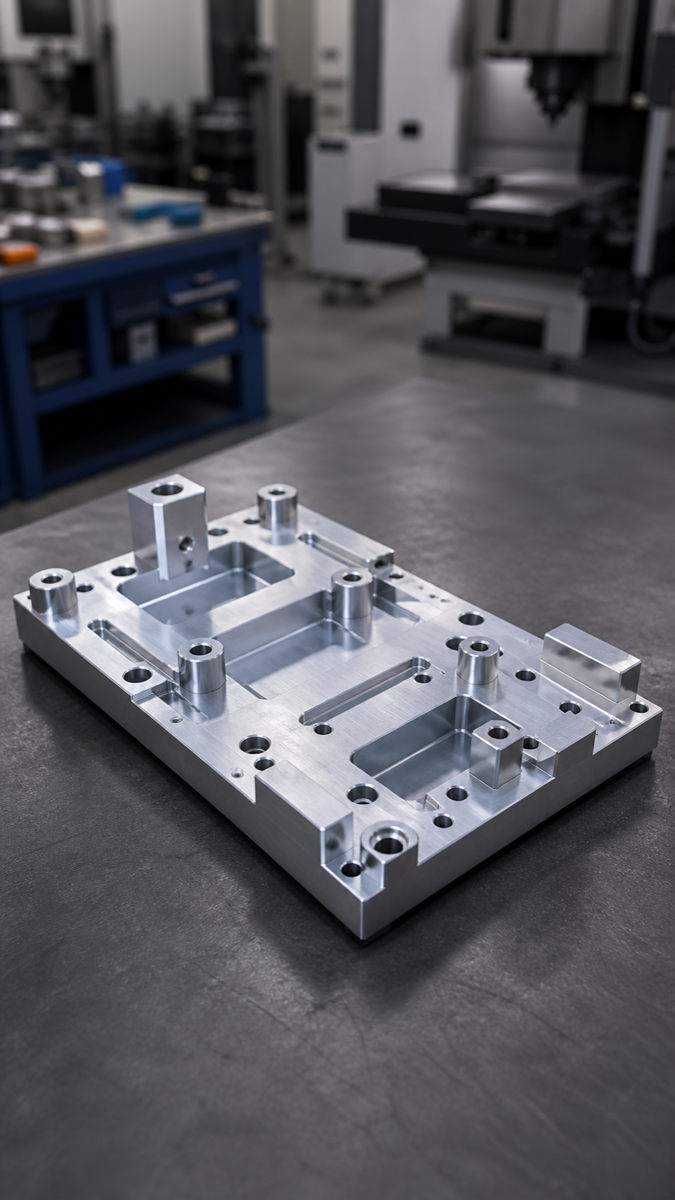
In CNC machining, soft jaws and hard jaws are not simply two names for clamping. They represent different risk strategies. Hard jaws are standard, rigid and fast. Soft jaws are machined or modified to match the part shape, so they can support irregular profiles, thin walls and precision second-operation datums more carefully.
For robot precision parts, fixture choice can decide whether holes, flatness, coaxiality and surface quality stay stable. A good supplier should explain the clamping plan, not only the machine model.
Core Difference
| Comparison | Hard jaws | Soft jaws |
|---|---|---|
| Fixture type | Standard jaws with high rigidity | Machined to match the workpiece profile |
| Best use | Regular stock, rough machining, parts with strong clamping faces | Irregular parts, thin walls, second operations and precision datums |
| Surface protection | Higher risk of clamp marks | More contact area and better surface protection |
| Repeat positioning | Depends on regular clamping faces and operator consistency | Can be built around the required datum |
| Setup cost | Fast and low initial cost | Needs jaw machining and validation |
| Main risk | Localized force may deform or mark the part | Poor jaw design can still create datum drift |
When Hard Jaws Are Enough
Hard jaws are useful for rough machining, square or round stock, simple brackets, ordinary covers and parts where clamp marks will be removed later. They are fast, stiff and cost-effective at the early material-removal stage.
The risk rises when the same hard jaws are used for finishing thin walls, functional faces or multi-direction hole relationships. Concentrated clamping force can bend the part while it looks correct on the machine.
| Part situation | Hard jaw suitability | Reason |
|---|---|---|
| Rough stock with large allowance | Good | Clamp marks are removed later |
| Regular aluminum or steel block | Good | Stable contact and fast setup |
| Simple low-risk cover | Acceptable | Critical features are not in the clamped area |
| Thin-wall robot bracket | Not preferred | Clamp force can create local deformation |
| Finished anodized part rework | Risky | Surface marks and scratches are likely |
When Soft Jaws or Combined Fixtures Help
Soft jaws help when the part has an irregular outline, limited clamping area, thin walls, precision dowel holes or a second-operation datum. They can be combined with locating pins, vacuum support, stop blocks or 5-axis machining to reduce re-clamping error.
| Project condition | Suggested fixture | Why it helps |
|---|---|---|
| Thin-wall aluminum robot structure | Soft jaws plus staged machining | Reduces distortion and spring-back |
| Irregular bracket outline | Custom soft jaws | Supports the profile and improves repeatability |
| Second-operation hole finishing | Soft jaws plus locating pins | Keeps datums stable |
| Large thin plate or cover | Vacuum support plus mechanical stops | Avoids point clamp marks |
| PEEK or POM parts | Soft jaws with light clamping | Avoids material damage and heat-related drift |
| Complex 5-axis bracket | Soft jaws plus multi-axis strategy | Reduces flips and datum transfer error |
Risks of Choosing the Wrong Fixture
| Risk | Common cause | Result |
|---|---|---|
| Thin-wall deformation | Hard jaws concentrate force | Part springs back after unclamping |
| Hole position shift | Second setup repeats poorly | Dowel holes or bearing bores do not assemble |
| Surface marks | Small contact area or no protection | Anodizing makes the defect more visible |
| Coaxiality drift | Functional datums are split across setups | Robot joint resistance or wear increases |
| Batch variation | Manual indicating differs each time | Small batches lose consistency |
How Buyers Should Ask About Fixturing
Fixturing should be discussed before quoting when the part is thin, irregular, surface-treated, second-operation sensitive or has tight datum relationships. A supplier who says the part can be made but cannot explain where it will be clamped is not giving the buyer enough risk information.
| RFQ question | What it reveals |
|---|---|
| Will this part use hard jaws or soft jaws? | Shows whether the supplier reviewed the part shape |
| Will clamping affect critical dimensions? | Checks deformation risk |
| How will thin-wall areas be supported? | Shows whether vacuum or staged machining is needed |
| How will second-operation repeatability be controlled? | Looks for pins, stops, soft jaws or inspection feedback |
| Will first article CMM data be provided? | Confirms the process with actual measurements |
| Can the same fixture be reused for the next small batch? | Improves repeat order consistency |
FAQ
Are soft jaws always better than hard jaws?
No. Hard jaws are efficient for regular stock and rough machining. Soft jaws are better when shape, surface protection, thin walls or repeat positioning create risk.
When are custom soft jaws necessary?
They should be evaluated when the part is irregular, has limited clamping area, tight holes across several directions or high repeatability requirements.
Can vacuum fixtures replace soft jaws?
Not completely. Vacuum support is useful for large thin faces, while soft jaws support profiles and repeat datums. Complex parts often use both.
Do soft jaws increase cost?
They add setup work, but they can reduce scrap, rework and inspection disputes when the part has real precision risk.
What should buyers include in the RFQ?
Send drawings with critical datums, surface requirements, quantity, inspection needs and notes about thin-wall or finished surfaces.
Summary
Soft jaws and hard jaws are both useful, but they solve different problems. Hard jaws are fast and rigid for regular roughing. Soft jaws are better for thin-wall robot parts, irregular brackets, second-operation datums and protected surfaces. Asking about the fixture plan is often more useful than asking only about the CNC machine model.
Ready to get a quote for your CNC machined parts? Submit your engineering drawings to qiancj@oemach.com. We support prototype sampling & small-batch production with strict tolerance control.