
Whether complex cavity parts are suitable for five-axis one-time clamping depends on whether the functional surface is accessible, whether the datum can be continuously transmitted, and whether the accuracy requirements involve post-machining. In the five-axis machining review, OEMach will first distinguish between features that can be completed within the same coordinates and critical surfaces that must be processed twice.
Many complex cavity parts seem to be suitable for five-axis machining, but "can be machined" does not mean "should be completed in one go". The most valuable aspect of one-time clamping is to reduce the relative position error caused by turning over multiple functional surfaces. However, some deep holes, extremely high surface requirements, correction surfaces after heat treatment, or locations greatly affected by clamping may still require secondary machining or special processes.
Key project confirmation items
| Structural features | The value of one clamping | Situations that may require secondary machining |
|---|---|---|
| Faceted flanges and side holes | Reduce positional deviation caused by turning over | Insufficient lateral space or need for special boring tool |
| Deep cavities and thin walls | Continuous machining avoids repeated alignment | Insufficient rigidity, easy deformation or intermediate aging required |
| High precision inner hole | The relative relationship between the hole and the external interface is more stable | Correction or grinding required after heat treatment |
| Sealing surface and stop | Facilitates unified control of spatial position | Higher surface roughness, grinding or post-machining requirements |
First determine whether the functional surface can really be covered in one clamping
When the cavity has high positioning requirements between the oblique flange, side holes, inner cavity bottom surface and external positioning surface, the five-axis can enable these features to be completed in the same coordinate system. During the review, it is necessary to check whether the tool can enter, whether the fixture is blocked, whether the part is rigid enough, and whether the same master datum still needs to be reused after flipping. If the tool accessibility or clamping stability is insufficient, forced clamping may increase the risk.
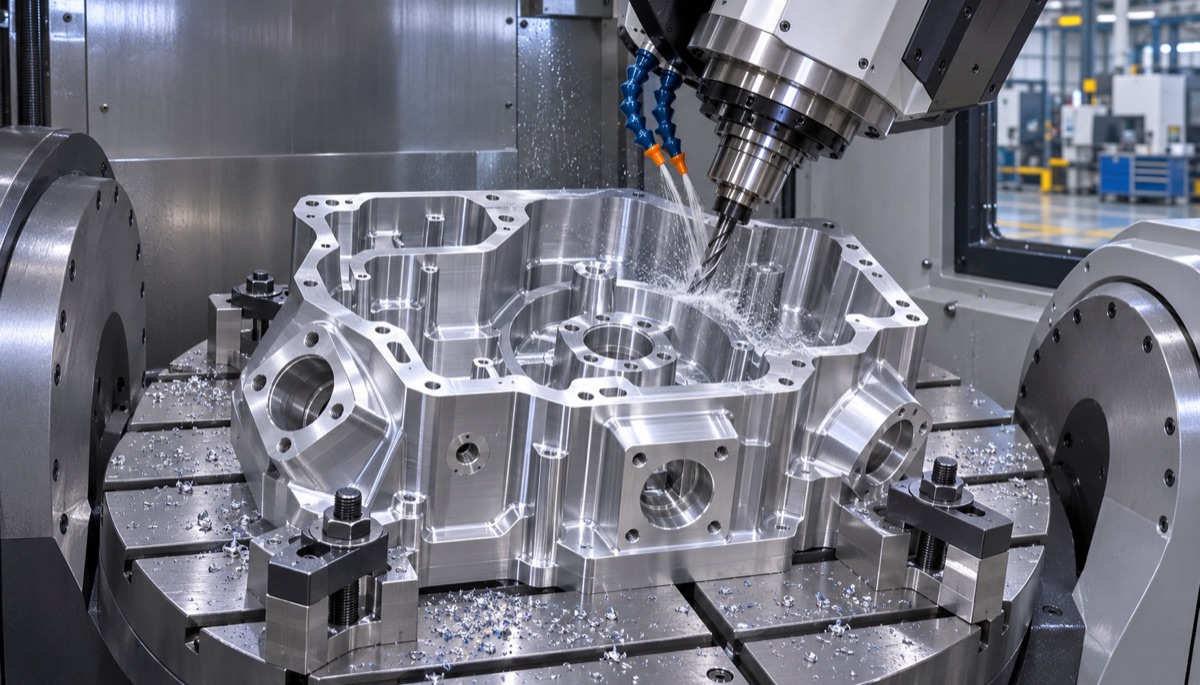
Five-axis linkage machining of complex aluminum alloy cavities with multi-faceted interfaces.
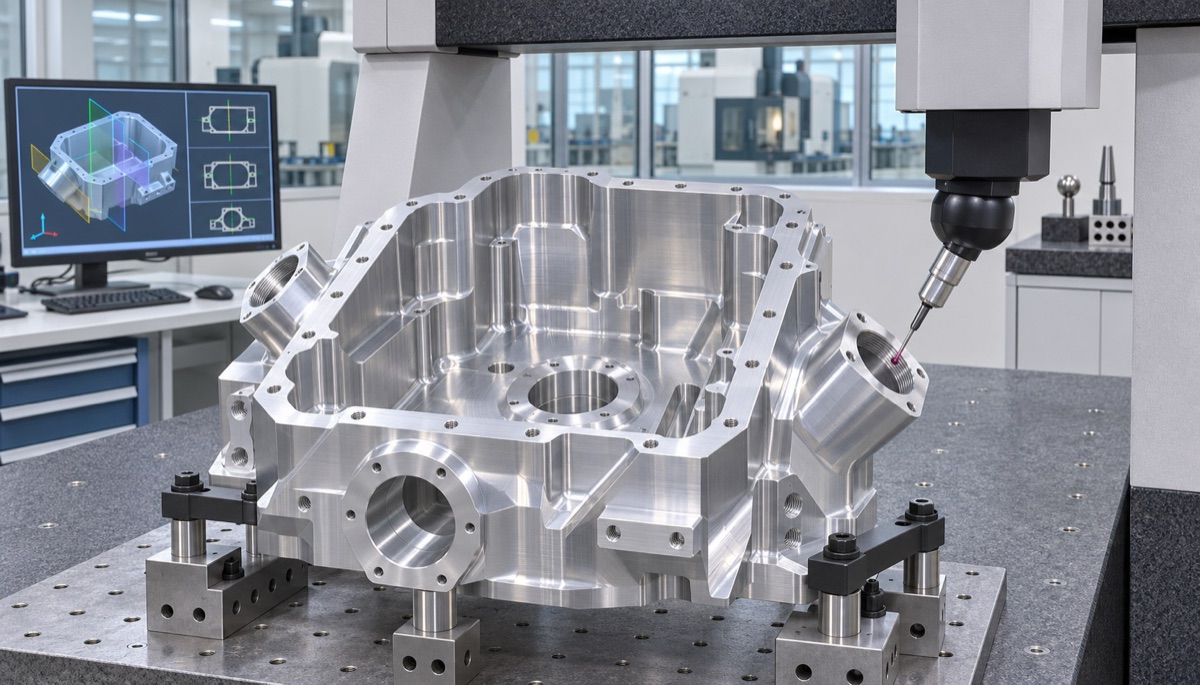
Three-coordinate inspection of lateral interfaces, inner cavities and installation datums of complex cavities.
Secondary machining is not failure, but risk control
For precision correction after heat treatment, local grinding, ultra-deep holes or features that require special inspection standards, it is more secure to arrange a secondary process. The key is that the secondary positioning should be able to return to the design basis, rather than temporarily relying on the appearance. If the R&D side can clarify the functional benchmark, non-machining surface and allowable clamping area in the drawings, the machining side can provide a reasonable process route earlier.
The process boundaries need to be clarified before quoting
Quotation differences for complex cavities often come from the number of setups, tool accessibility, material allowance, inspection requirements and post-machining. The actual difficulty cannot be judged by just looking at the dimensions. OEMach recommends providing three-dimensional models, material grades, key geometric tolerances, surface treatments and assembly interfaces when enquiring, making the choice between primary clamping and secondary machining transparent.
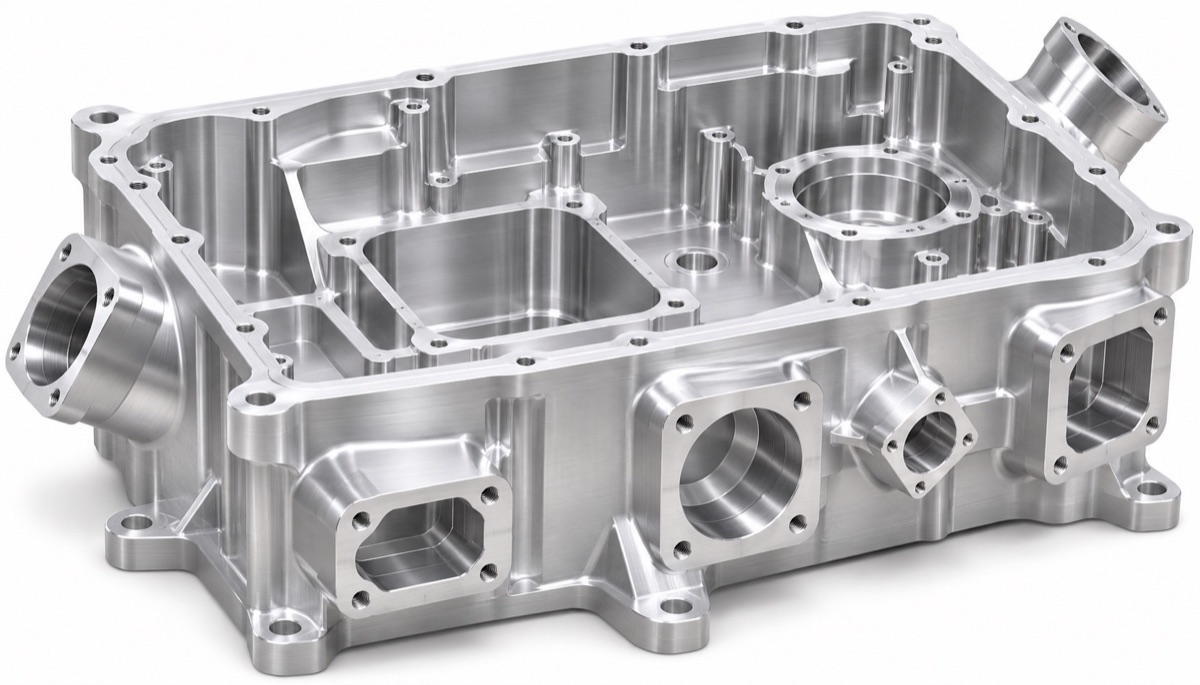
Complete machined complex cavity parts and their multi-faceted flange interfaces.
Summary
The value of five-axis machining is to keep the truly relevant functional surfaces in the same coordinates, rather than pursuing all surfaces to be completed at once. Only by clarifying which surfaces must be transferred continuously and which surfaces are suitable for post-machining can accuracy, cost and delivery time be taken into consideration.
FAQ
Is five-axis machining necessarily more accurate than three-axis machining?
Not necessarily. The advantage of five-axis is that it handles multiple faces and complex spatial relationships; the final accuracy also depends on the datum, clamping, tooling and inspection scheme.
What parts are more suitable for one-time clamping?
Structures that require a high relative relationship between multi-faceted interfaces, oblique holes, lateral holes and critical surfaces are usually more valuable.
Why do deep cavity parts sometimes still need secondary machining?
May be affected by tool stiffness, chip evacuation, setup stability, or correction requirements after heat treatment.
What costs can be reduced by one clamping?
Repeated alignment, special fixture changeover and partial clamping work are usually reduced, but this does not mean that all processes are cheaper.
How to give an accurate quotation for five-axis parts?
It is recommended to provide 3D models, materials, quantities, critical tolerances, surface treatments, assembly interfaces and delivery requirements.
Ready to get a quote for your CNC machined parts?
Submit your engineering drawings to qiancj@oemach.com. We support prototype sampling and small-batch production with strict tolerance control.