
Strategic suppliers are not "machining plants with long cooperation time", but partners who have the ability to match key parts, can undertake frequent changes, have stable delivery evidence, and are willing to work together to improve and manage risks transparently. Completely answer the machining difficulties, solutions, testing capabilities and project input information around the search requirements to facilitate R&D and procurement evaluation.
First use real drawings and continuous small batch verification capabilities, and then use quality, delivery, engineering response, change, cost and risk data to grade; strategic cooperation should be based on repeatable results and governance mechanisms for both parties. The specific process still needs to be combined with process understanding, real production capacity, quality evidence, version changes, outsourcing transparency, response mechanism, delivery performance, business continuity and supply risk confirmation.
Process Control Checklist
| FAQ | main reason | control action | Evidence of acceptance |
|---|---|---|---|
| The sample performs well, but subsequent batches fluctuate greatly. | Samples rely on personal experience, and tooling, tools, procedures and inspections are not solidified. | Require process baselines, critical parameters and first article release rules and compare consecutive batch data | Version records, process data, inspection reports and batch trends |
| Positive communication but slow to close issues | There is no responsible person, time limit, isolation scope and root cause verification mechanism | Establish abnormal escalation and 8D or equivalent closed loop, record temporary measures and effectiveness verification | Response times, closure cycles, repeat issues and verification evidence |
| Certificates are complete but key processes are out of control | The certification scope, on-site execution or outsourced control do not match this project | Verify certificate scope and review actual processes, personnel, equipment and outsourced releases | Certificate scope, audit records, outsourcing list and finished product release |
Define the demand profile first instead of finding the factory first
The procurement team should first organize the materials, size range, typical structure, key tolerances, monthly variety number, single batch quantity, surface treatment, inspection data, expediting ratio and change frequency for the next six to twelve months. It is also important to distinguish which parts affect safety, performance or installation time, and which parts can be covered by general suppliers. NIST supply chain resources treat supplier segmentation, evaluation selection, total cost of ownership, and strategic relationships as distinct but connected efforts; without demand profiling, a supplier's equipment inventory cannot be matched to a project.
Technical review requires evidence of similar processes
On-site audits shouldn’t just count machine tools. Suppliers should be asked to illustrate functional benchmarks, setups, tooling, thin wall or deep cavity risks, first article, in-process inspection and final measurements with representative drawings. Check anonymous process records of similar materials and structures, tooling reassembly results, CMM procedures and exception handling to confirm whether key positions rely on a single person. Outsourcing heat treatment, grinding, surface treatment and calibration should also list responsibilities, technical agreements, traceability and return to factory for re-inspection.
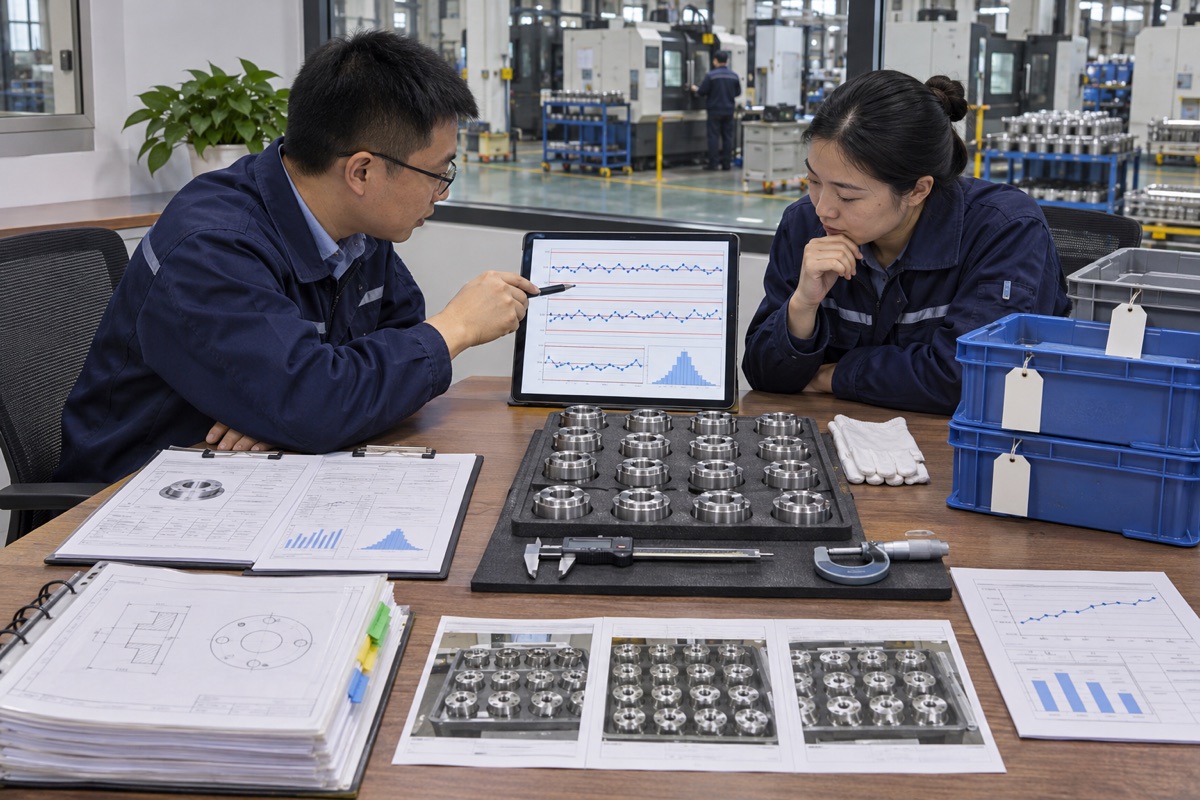
Supplier audits should determine competency from similar parts and real process evidence.
Use test orders to verify from prototype to reproduction
It is recommended to arrange a sample with a representative craftsmanship first, and then arrange two to three rounds of small batches. Prototypes are used to verify understanding and manufacturability, and small batches are used to observe tooling repeatability, tool life, batch consistency, packaging and data integrity. The first DFM response, quotation assumptions, first-pass, issue closure, delivery deviations and version errors are recorded during the assessment. A single pass cannot prove long-term capabilities, and recovery performance after consecutive batches and abnormalities is more distinguishable.
Create scorecards that drive action
The scorecard can be weighted by quality, delivery, engineering response, change control, cost transparency, outsourcing management, compliance, and continuity, but the weights should vary with part risk. Quality looks not just at return rates, but also at critical dimensional trends, reporting completeness, and repeat issues; delivery looks at not just average days, but accuracy of promised dates. The price should evaluate the components of materials, programming, tooling, testing, expediting and rework to avoid the lowest unit price covering up the costs of communication, line shutdown and rework.

Long-term cooperation must be supported by continuous batches, abnormal closed loops and delivery performance.
Strategic relationships require governance by both parties
After the upgrade, fixed window personnel, monthly or quarterly performance reviews, production capacity and key equipment plans, drawing change sign-off, exception upgrades, forecast sharing, joint DFM and annual cost reduction lists should be established. The purchaser should also improve the quality of input, freeze versions in a timely manner, give acceptance boundaries and provide feedback as agreed. ISO 10007 emphasizes that configuration management runs through the product and service life cycle; if there is no configuration control in projects that frequently change drawings, no matter how good the machining capabilities are, they will be offset by version chaos.
Keep backups and verify business continuity
Strategic cooperation does not mean single source. For key parts, single point risks of materials, key equipment, special tooling, programming data, outsourcing and personnel must be identified, and backup, data ownership, shutdown notification and recovery plans must be agreed upon. System certification can demonstrate the management framework but is not a substitute for project-level verification. OEMach recommends using trial orders and performance data to determine the level of cooperation, and retaining specific project boundaries for committed capacity, delivery time and yield.
OEMach project proposal
OEMach recommends first using representative drawings and a round of small batch orders to verify technical capabilities, and then using three to six months of quality, delivery, change and exception data to decide whether to upgrade to a strategic supplier. Long-term cooperation should be based on repeatable results and transparent collaboration, not on the number of devices, low one-time prices or a system certificate. When drawing process evaluation is required, materials, tolerances, quantities and delivery plans can be provided to OEMach.
Summary
First use real drawings and continuous small batch verification capabilities, and then use quality, delivery, engineering response, change, cost and risk data to grade; strategic cooperation should be based on repeatable results and governance mechanisms for both parties. If drawing process evaluation is required, it is recommended to provide material grade, heat treatment and surface treatment requirements, key tolerances, sample quantity and planned batch size in order to determine the clamping, machining and inspection plan.
FAQ
Do I have to choose the largest supplier?
No need. Small batches and multiple varieties pay more attention to process matching, engineering response, version control and flexible production capacity. Scale is only part of the continuity assessment.
Can the ISO 9001 certificate prove precision machining capabilities?
cannot be proven alone. The scope of certification should be checked and similar processes, measurements, personnel, records and project results reviewed.
Should strategic suppliers supply exclusively?
It is not appropriate to generalize. High-risk parts require evaluation of secondary sources, tooling and data portability, and recovery time.
Ready to get a quote for your CNC machined parts?
Submit your engineering drawings to qiancj@oemach.com. We support prototype sampling and small-batch production with strict tolerance control.