
Precision parts packaging is not safe just by "packing it in more layers". A reliable solution must simultaneously control the contact between parts, displacement within the box, moisture, contamination, material compatibility, transportation shock and unpacking method, and verify it with the arrival status or transportation test. Completely answer the machining difficulties, solutions, testing capabilities and project input information around the search requirements to facilitate R&D and procurement evaluation.
First, the parts are risk-graded, and then the inner packaging, barrier layers, buffers and outer boxes are designed; all anti-rust and moisture-proof materials must be confirmed for compatibility, and the packaging effect must be closed-looped by testing or real transportation data. The specific process still needs to combine parts cleaning and drying, single-piece isolation, critical surface and thread protection, moisture-proof and rust-proof material compatibility, box fixation, outer box marking, transportation risks and arrival acceptance confirmation.
Process Control Checklist
| FAQ | main reason | control action | Evidence of acceptance |
|---|---|---|---|
| Scratches or indentations after arrival | Parts are in contact with each other, key corners are suspended, and the cushioning material is inappropriate for bearing or rebounding. | Use one-piece positioning, soft isolation, end protection and limiting in-box movement | Photos before and after packaging, simulated vibration or trial shipment, arrival inspection records |
| Rust spots or water stains appear after opening the box | Parts are not sufficiently dried, ambient moisture enters, barrier packaging fails, or anti-rust solutions are incompatible | After cleaning and drying, seal it as soon as possible, and verify the combination of barrier, moisture-proof and rust-proof according to the storage and transportation cycle. | Encapsulation time, humidity indication, material compatibility and arrival status |
| The size is acceptable but it needs to be cleaned repeatedly before assembly. | Anti-rust oil, VCI, foam volatiles or packaging debris contaminate functional surfaces | Define cleanliness, allowable residues and subsequent cleaning methods in packaging specifications | Material Declaration, Cleaning Validation and Assembly-End Feedback |
Define parts and shipping risks first
Before packaging design, confirm the material, surface treatment, maximum and minimum dimensions, weight, thin walls and sharp edges, sealing surface, mating surface, threads, cleanliness, allowed contact area, storage period and transportation method. The protection logic of aluminum alloy anode parts, stainless steel passivation parts and bare steel parts in the same batch is different. Express parcels, full containers, and road and air shipments are also subject to different drops, vibrations, stacking, and heat and humidity. Without these inputs, unified foam or unified anti-rust bags can only be considered empirical solutions.
To prevent collisions, relative movement must be limited
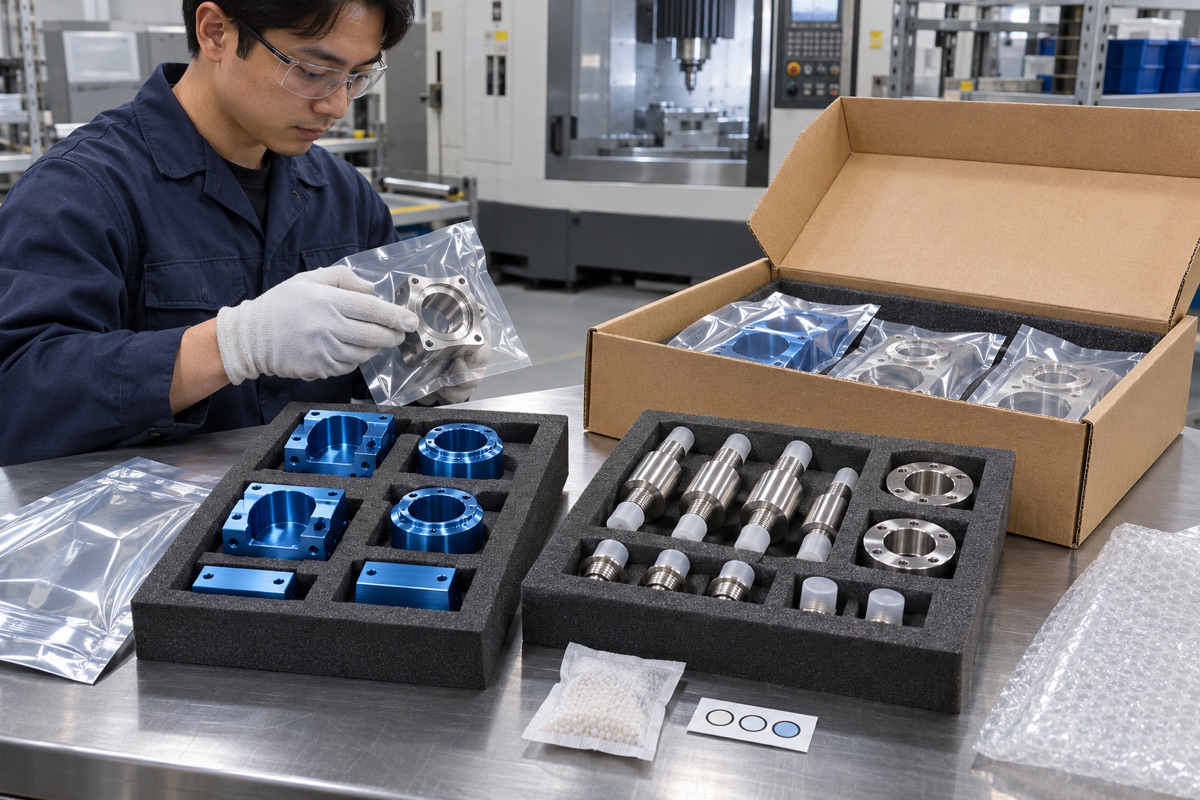
Scratches and dents often result from parts touching each other, parts rubbing against the case, protruding features hanging loose, or cushioning materials compressed and losing support. Precision parts should use single-piece acupoints, partitions, end protection and non-rolling positioning methods, and the key surfaces should not directly bear load. The density, thickness and rebound of the foam need to match the weight; if it is too soft, it will bottom out, and if it is too hard, the impact will be directly transmitted to the thin wall. Protective caps can be added to threads, holes and sharp corners, but the protective parts themselves must not produce particles or residual glue.
Individual component positioning, critical surface protection and material compatibility are the basis for preventing scratches and contamination.
Cleaning and drying determines the starting point of rust prevention
Machining fluids, fingerprints, cleaning agent residues and crack moisture will continue to act after encapsulation. Before packaging, cleaning, rinsing, drying and status confirmation should be completed according to the purpose of the parts, and the exposure time from drying to bag sealing should be shortened as much as possible. Bare steel may require anti-rust oil, VCI or barrier packaging; stainless steel passivation parts must still avoid iron contamination and chloride; anode aluminum parts must prevent alkaline, acidic or volatile materials from damaging the surface. The plan should be verified based on materials and applications, and "passivation" should not be understood as meaning that it will not corrode in any environment.
Moisture and rust resistant materials must be compatible
Desiccant, humidity indicator card, VCI film, aluminum-plastic barrier bag, anti-rust paper and oil film each have their own applicable conditions. It is necessary to confirm the sealing integrity, expected water vapor ingress, storage and transportation cycle, packaging volume, temperature and humidity environment and handling requirements after unpacking. Electronic, optical, vacuum, medical or subsequently bonded parts also need to limit volatiles, fibers and oil residues. Dissimilar metals should not be in direct contact to avoid increasing the risk of galvanic corrosion in humid environments. Unverified desiccant dosages and rust-proof expiration dates should not be written as general promises.
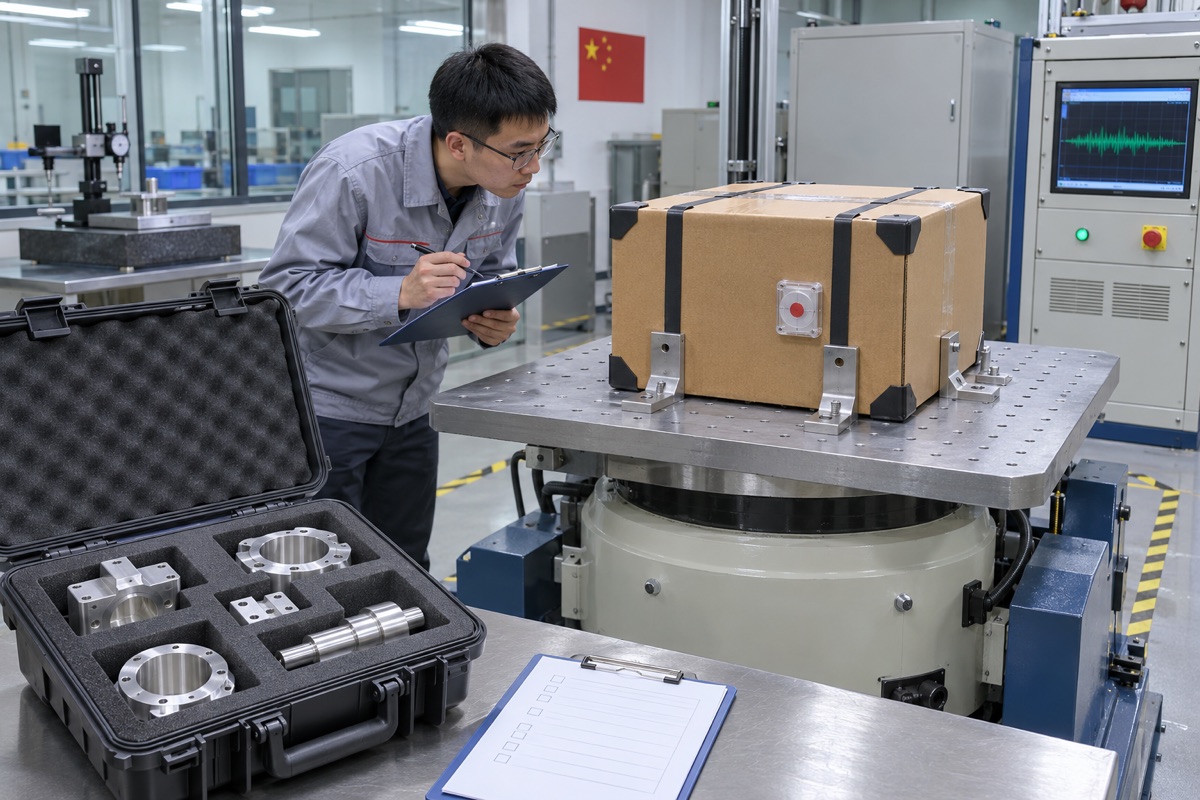
Whether the packaging is effective is verified through testing matching the transportation environment or real arrival data.
Carton identification and packing records must be executable
ISO 780 stipulates a general system for transportation, packaging, handling and storage icons, but the identification is valuable only when the logistics can be identified, and the direction and center of gravity are really important. The packing list should correspond to the part number, version, quantity, batch and packaging level, and record photos, bag sealing time and humidity status if necessary. The outer box must have sufficient compression resistance and sealing strength, and no gaps should be left inside to allow parts to accelerate and collide. The order of unpacking should also be clear to avoid parts being scratched by knives or being stacked incorrectly.
Use transportation testing or real arrival to close the loop
ISTA divides the test areas into types such as integrity screening, partial simulation and general transportation simulation, and the selection should match the product weight, packaging form and distribution environment. Small batch projects can be subjected to representative drops, vibrations or test runs first, and the qualification standards for parts and packaging can be defined before testing. OEMach recommends that feedback on the bumps, rust, contamination, and unpacking of the arriving goods be written back into the packaging specifications. This article does not replace specific transportation standards, hazardous materials regulations, or customer cleanliness requirements.
OEMach project proposal
OEMach recommends considering packaging as the last step in the manufacturing process. First classify according to material, surface treatment, geometric vulnerability, storage and transportation cycle and transportation method, and then determine the isolation, moisture-proof, rust-proof and buffering plan; any VCI, anti-rust oil, desiccant or protective film must first be confirmed to be compatible with the part material, cleanliness and subsequent assembly processes. When drawing process evaluation is required, materials, tolerances, quantities and delivery plans can be provided to OEMach.
Summary
First, the parts are risk-graded, and then the inner packaging, barrier layers, buffers and outer boxes are designed; all anti-rust and moisture-proof materials must be confirmed for compatibility, and the packaging effect must be closed-looped by testing or real transportation data. If drawing process evaluation is required, it is recommended to provide material grade, heat treatment and surface treatment requirements, key tolerances, sample quantity and planned batch size in order to determine the clamping, machining and inspection plan.
FAQ
Do precision parts need to be vacuum packed?
No need. The isolation method should be selected based on the material, storage and transportation cycle, humidity risk and cleanliness requirements; vacuum may also cause the bag body to crush sharp edges or thin walls.
Is it possible to avoid moisture-proofing after passivation of stainless steel?
It is not recommended to infer this. Passivation enhances corrosion resistance, but surface contamination, chlorides, standing water, and packaging materials can still cause problems.
Is the thicker the foam, the safer it is?
Not necessarily. The buffer needs to match the weight and impact of the part. If it is too soft, it will bottom out, if it is too hard, it will transmit the impact, and the material must be checked for chipping and chemical compatibility.
Ready to get a quote for your CNC machined parts?
Submit your engineering drawings to qiancj@oemach.com. We support prototype sampling and small-batch production with strict tolerance control.