
Representative scope without a claimed tray project
This case proposes a 316L knurled thumb nut for an inert medical tray positioning fixture study. It is a representative manufacturing example, not a documented customer order, shipment or approved tray component. No attained tolerance, clamping force, tightening result, certification, usability outcome or operating compatibility is asserted. The case organizes requirements to resolve before a real machining order. It separates the proposed fabrication and inspection of the individual nut from qualification of the complete fixture and its interaction with medical equipment, including any loads, cleaning exposure or handling requirements that need independent assessment.

Proposed nut geometry and excluded features
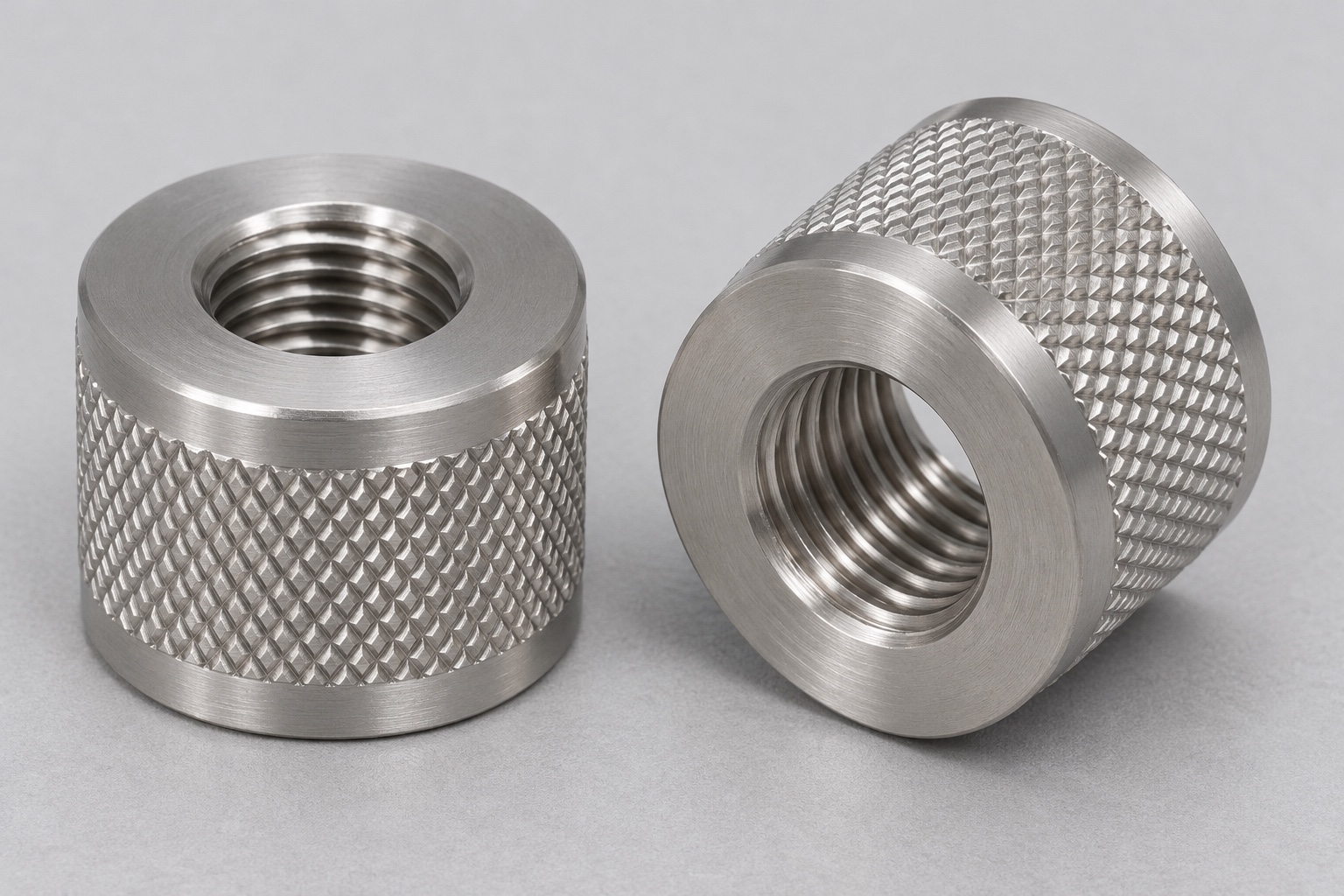
The proposed part is a plain short cylinder with a diamond-knurled middle band, narrow smooth bands at both ends, flat annular end faces and one centered internally threaded axial through-bore. It has no flange, external shaft, side hole, slot, insert or assembled screw. The smooth bands keep the pattern's extent explicit rather than allowing the texture to spread across all surfaces. Dimensions, thread designation, profile and permitted transitions would come from an approved drawing. A photo of a thumb nut would not authorize an extra locking feature, assumed standard fit or different gripping mechanism.
Define the mating reference and intended contact
The fixture designer would identify the screw reference, useful engagement and the end face intended to contact another surface. Review access, clearance and any features that must remain free before choosing tolerances. A textured exterior does not establish a suitable tightening method or clamping capacity. If an inert assembly observation is requested, both component revisions and the condition would be controlled. The observation would support only its defined scope, not tray safety, vibration resistance or cleaning performance. These responsibilities should be assigned separately from the drawing acceptance of the proposed nut itself.
RFQ inputs for a real custom nut
A real inquiry would include drawing revision, model, quantities, material definition, thread system and limits, useful length, knurl pattern, smooth bands, final envelope and surface condition. It would identify required measurements and visual criteria. The quotation would state open DFM issues such as texturing load, gripping access and operation order rather than selecting missing acceptance criteria. If a particular knurling route is required, say so; otherwise any proposed route must still meet the approved geometry. Additional treatment, cleaning or functional testing would have its own defined scope and evidence instead of being implied by the medical application.
Material control and proposed blank preparation
Identified 316L stock would be linked to the required documentation. Blank preparation would reserve material for the cylinder, bore, thread, end faces and any sacrificial holding allowance. Material and revision would remain associated with the part through texturing, transfer and outgoing cleaning. If direct marking is restricted, a traveler and container would preserve identity outside functional surfaces. A stainless appearance is not a certificate, while a certificate is not proof of final dimensions. This proposal provides no actual material or treatment result; it explains which records a real manufacturing order would need to maintain.
Proposed turning, threading and knurling sequence
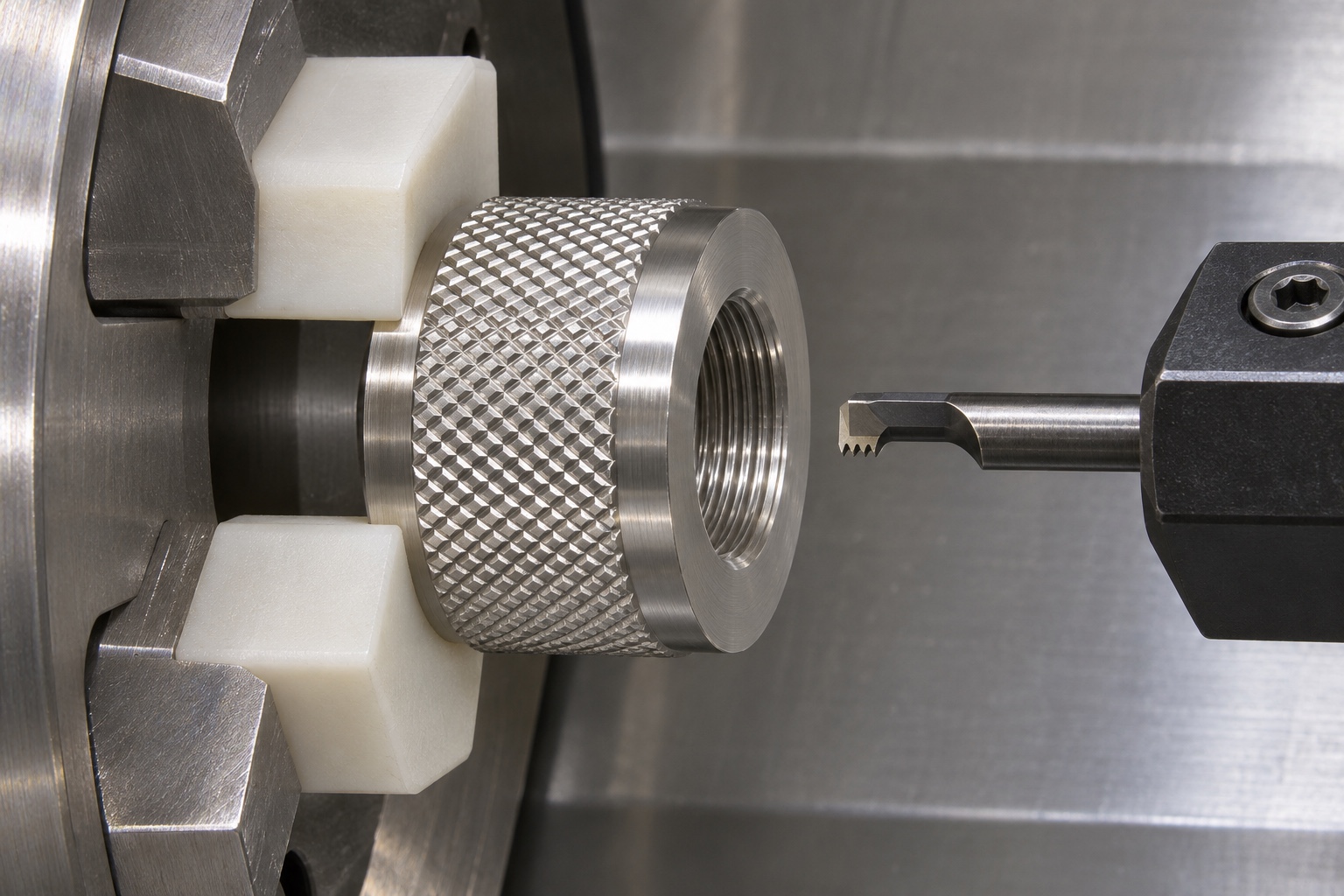
The process plan would coordinate accessible round features, internal thread and the outer texture, including how a transfer protects completed surfaces. It would review the chosen knurling process and the wall remaining around the bore. Form and cut knurling differ in material action and process loading, so blank preparation and final-envelope control would be selected accordingly. The plan would not assume the preturned diameter is the final knurled diameter. Tooling and parameters would depend on actual material, machine and geometry. A plausible setup image is not evidence of a customer route, cycle time or attained precision.
Smooth bands, thread entries and final edge control
The drawing would preserve the boundaries between texture, smooth bands and end faces. Deburring would remove unintended edges without damaging thread profile, reducing useful engagement or erasing the intended seating area. The knurl would be reviewed for unwanted raised edges and loose material after all relevant operations. A broad polishing step would not replace defined requirements or create an approved pattern automatically. Any proposed relief, wider band or changed transition would require review before incorporation. Relevant features would be reinspected after finishing rather than accepted from readings taken before the final geometry was established.
Proposed thread and outside inspection methods
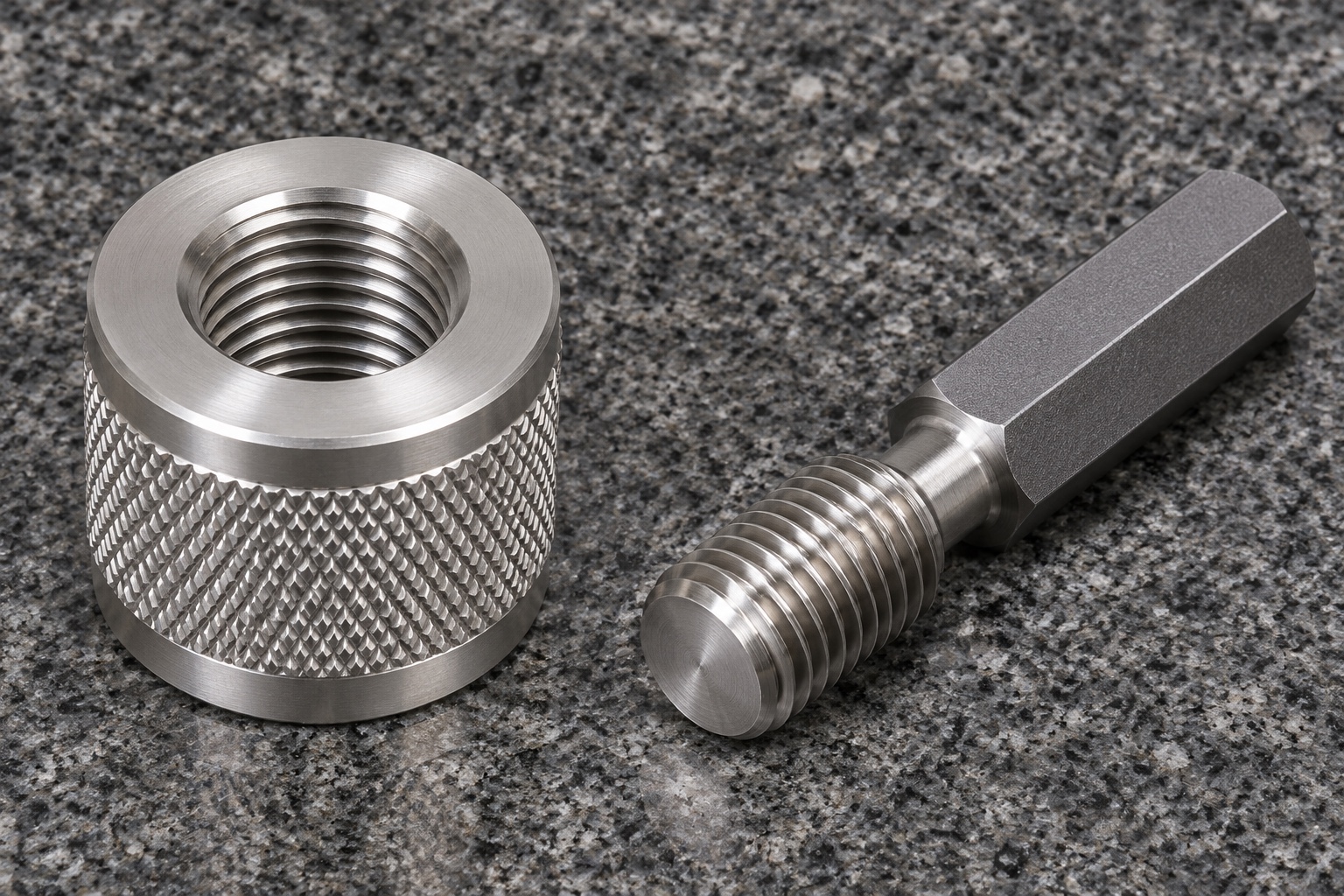
An approved thread plug gauge would address the specified thread acceptance, with identity, condition and method recorded. Separate measurements would address height, end faces, smooth bands, textured envelope and required relationships. Measurement contact on the knurl would be chosen for the acceptance question rather than an arbitrary pair of peaks. A sample screw could support a supplementary observation but would not automatically replace inspection. Gauge photographs show possible equipment, not measured conformity. The plan would declare inaccessible features and method limits before release and avoid reporting CAD nominal values as results from manufactured parts.
First-article record in the actual final condition
A real first-article record would link the revision, material, final state, references, methods and readings. It would distinguish visual texture criteria from measured dimensions and thread-gauge outcomes. The supplied condition after threading, knurling, edge work and any approved treatment would govern acceptance. Earlier measurements could support process control but would not silently represent a later state that may have changed. The record would show what was actually evaluated and any approved exceptions. This case offers a proposed evidence structure; it does not claim a completed inspection, accepted production lot or universal manufacturing capability.
Supplementary inert assembly observation and limits
With a known screw reference, the team could observe starting, access and whether the designated end reaches the intended fixture contact. The record would identify reference revision and assembly condition. A favorable hand fit would not override failed dimensional requirements or establish tightening torque, clamp force, grip usability, loosening resistance or repeated service life. A problem could originate in either component and would be interpreted with individual inspections. This proposal does not report a successful customer trial. Any evaluation of an operating tray system would remain a separate task for the responsible designer with appropriate conditions and evidence.
Outgoing cleaning and protective packaging proposal
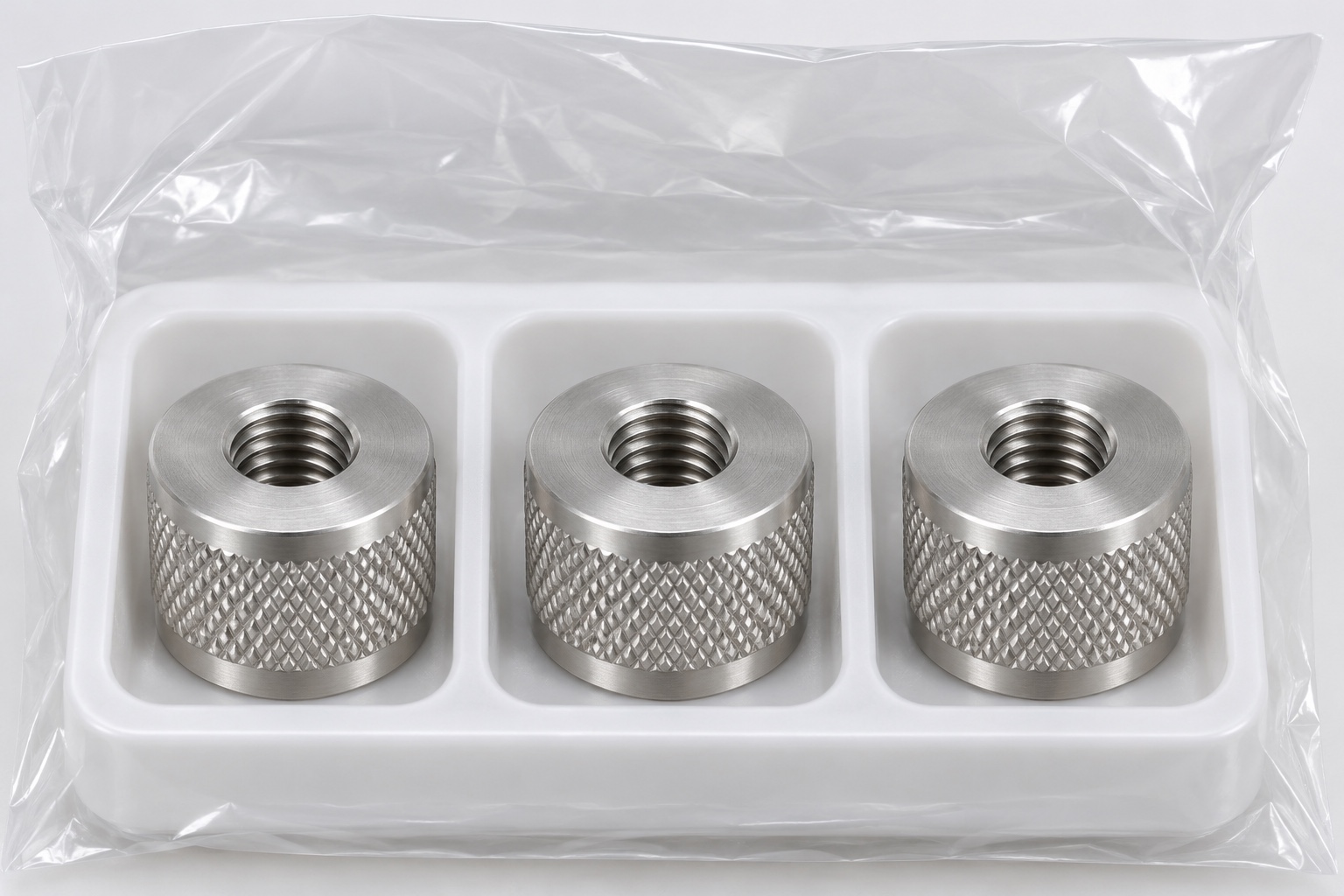
The outgoing condition would address machining debris in the internal thread, knurl valleys and band transitions. Specific residue limits would need approved cleaning and verification methods. Packaging would separate nuts to prevent textured surfaces from scratching adjacent functional faces or thread entries. Identification would link the package to material, revision and inspection records outside sensitive regions. A tray and open bag would not be a sterile barrier, validated cleaning result or shipping qualification. No actual shipment or cleanliness outcome is asserted. Receiving checks would distinguish packaging condition from component acceptance and state any review needed before assembly or storage.
Approval path for a real stainless small batch
Before production, the parties would approve drawing, model, 316L definition, quantity, thread, texture, final envelope, inspection and packaging. DFM review would resolve process selection, load and support, protected gripping, end-face finishing and gauge access. Actual first-article evidence would then document manufactured parts and accepted changes before repeat orders. Inert assembly observations and complete-fixture qualification would remain separately controlled. The proposal supports a focused request for medical stainless components without inventing customer results, attained precision or clamping performance that the proposed turning and inspection route does not independently establish.
FAQ
Is this a documented medical tray customer delivery?
No. It is a representative manufacturing proposal for an inert positioning fixture. It does not document a customer, shipment, achieved tolerance, certification, gripping result or successful use in operating equipment.
What features are included in the proposed nut?
A cylindrical body, diamond-knurled middle band, smooth end bands, flat annular ends and one internally threaded through-bore are proposed. There is no flange, external shaft, side hole, insert or assembled screw.
Does the case prescribe form knurling for every part?
No. The selected process must be reviewed for the actual geometry, material and required result. Form and cut knurling have different material actions and loading and should not be treated as identical routes.
What would the thread plug gauge establish?
Only the thread acceptance covered by its designation and approved procedure. It would not establish nut height, textured envelope, end-face geometry or every relationship required by the drawing.
Would a hand-fit observation prove clamp force?
No. It would support the defined starting, access or contact observation with a controlled inert reference. Clamp force, torque limits, loosening, usability and service life require separate appropriate evaluation.
What is needed before a repeat small-batch order?
Approve the revision, material, thread, knurl, final envelope, surface condition, inspection and packaging. Preserve real first-article evidence and changes rather than treating this proposed route as achieved production results.

tanghangyun@oemach.com