
Representative scope without a claimed customer delivery
This case proposes a manufacturing route for a 316L threaded support stud used in an inert medical wash-basket fixture study. It is a representative machining example, not a documented customer order, shipment or completed equipment validation. No achieved tolerance, load rating, cleaning result, certification or production capacity is asserted. The useful question is how the thread connection, disc-foot seating surface and manufacturing references would be defined before a real order. Qualification of a working basket assembly remains separate from the proposed fabrication and inspection of this individual component.

Proposed one-piece component geometry
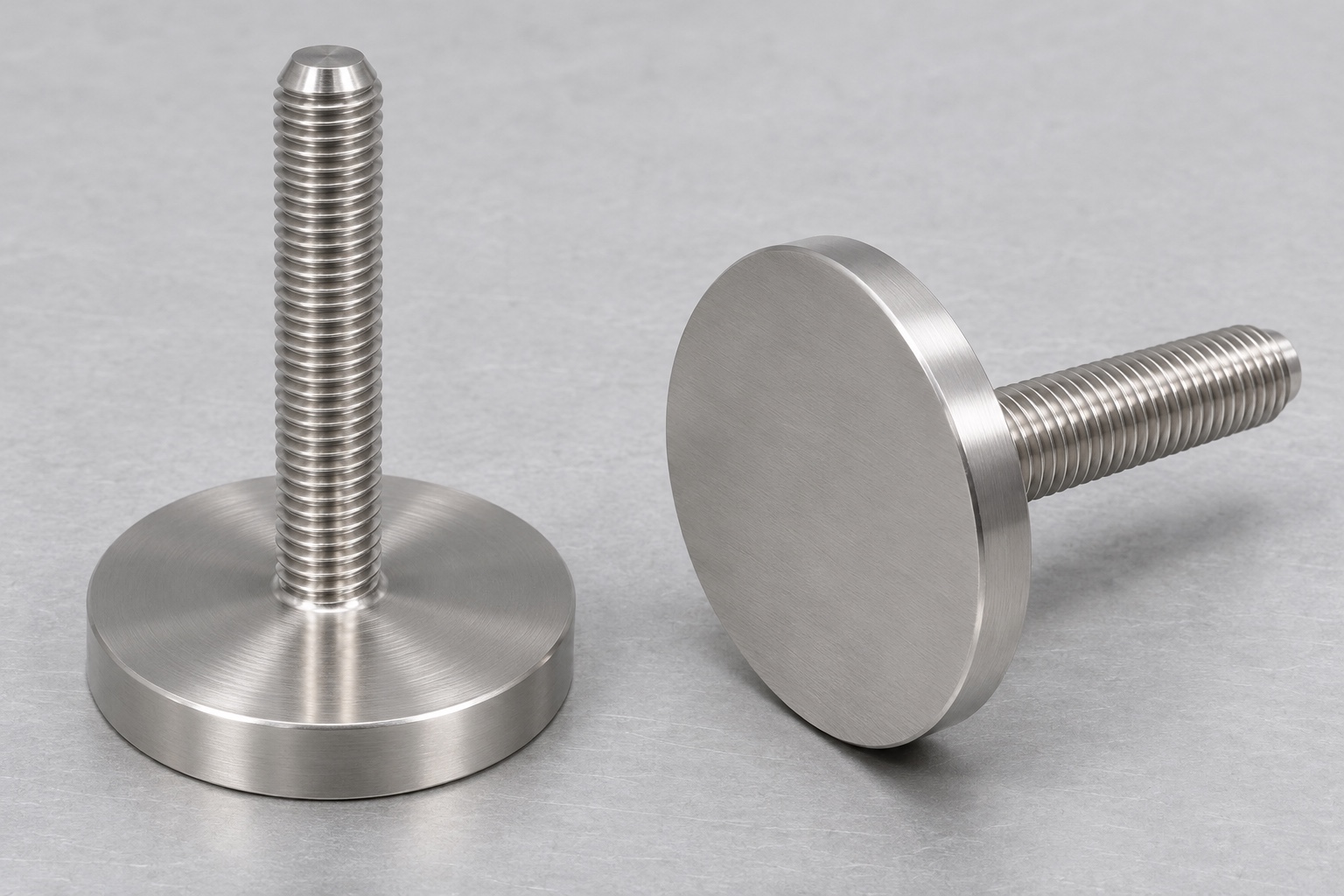
The proposed part has a low circular disc foot and a smaller centered cylindrical stem with an external helical thread and a chamfered tip. The foot underside is a plain seating surface. There is no axial hole, cross-hole, hex socket, separate nut, spring, rubber pad or swivel mechanism. These exclusions matter because a feature that looks convenient in an assembly cannot simply be assumed in the machining plan. Overall size, foot thickness, useful thread length and transition geometry would be assigned by an approved drawing rather than inferred from the images.
Define the mating reference and seating intention
The fixture designer would identify the mating internal thread and the surface against which the foot is intended to seat. Review available engagement, approach direction and surrounding clearances before setting tolerances. State whether the underside establishes a datum, supplies contact or merely provides clearance in the study. The disc shape does not itself establish anti-loosening behavior or a safe load path. An inert mating reference can support a limited assembly observation, but its definition and revision must be controlled before that observation has a useful interpretation for the proposed part.
RFQ inputs and acceptance responsibilities
A real inquiry would supply the drawing revision, model, quantity, material definition, complete thread callout, usable engagement, seating requirements and final surface condition. The buyer and manufacturer would agree which features need recorded measurements and which need a specified gauge. Clarify who supplies the mating reference and whether its use is supplementary or part of acceptance. Any required cleaning, passivation or additional test needs its own scope. This representative case cannot fill missing requirements with generic claims about medical machining, a standard workshop tolerance or an assumed customer expectation.
Material control and proposed blank preparation
The route would begin with identified 316L stock linked to the required documentation. Blank size would allow the disc foot, stem, workholding region and separation allowance to be produced without treating a sacrificial grip surface as a finished datum. Material identity would follow the part through secondary work and cleaning. A stainless appearance is not a material certificate, and a material certificate is not evidence that every finished dimension complies. If direct marking is restricted, containers and travelers would preserve traceability without adding an unapproved mark to the seating face or thread.
Proposed CNC turning and reference recovery
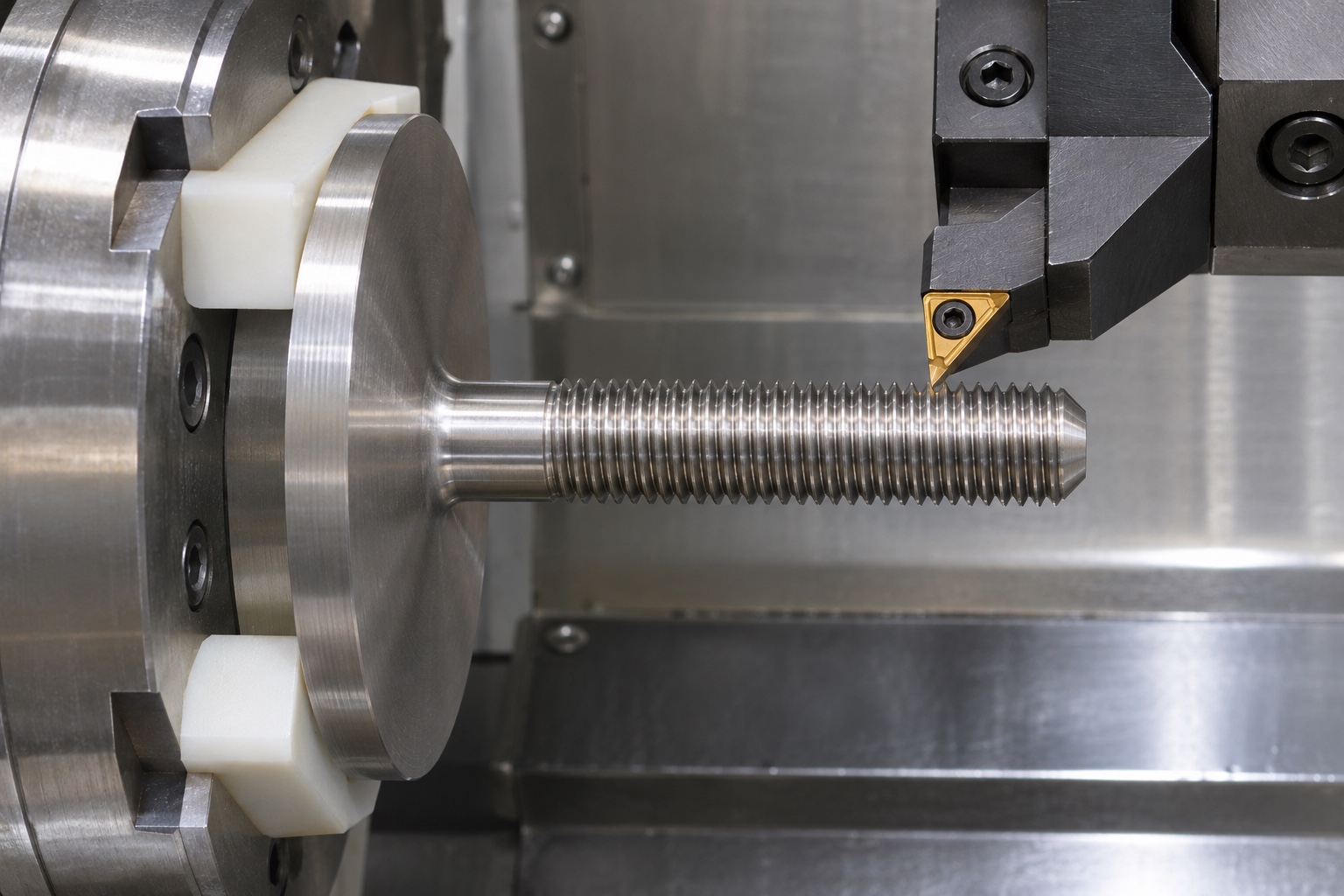
The turning plan would coordinate the stem, accessible foot features and external thread. Tool clearance near the disc would be reviewed before choosing the final transition. A second setup may be needed for the underside after separation from the stock; it would locate the part from approved references and protect finished surfaces. The plan does not assume that one setup completes every requirement. Workholding feasibility, cutting stability and reference recovery would need review with the actual dimensions. No cycle time, turning parameters or measured concentricity is presented as an achieved result.
Thread generation and edge control
The selected thread tooling would match the approved profile and provide clearance for the required useful length. The start chamfer and withdrawal region would be reviewed separately from the central full-profile turns. After machining, edge control would remove unwanted burrs without changing crests, shortening engagement or creating a relief that the drawing does not contain. The foot perimeter would also be inspected for handling edges. A polished-looking thread is not proof of fit. Any proposed geometry change would be returned for approval rather than hidden in a workshop deburring operation.
Proposed thread and dimensional inspection evidence
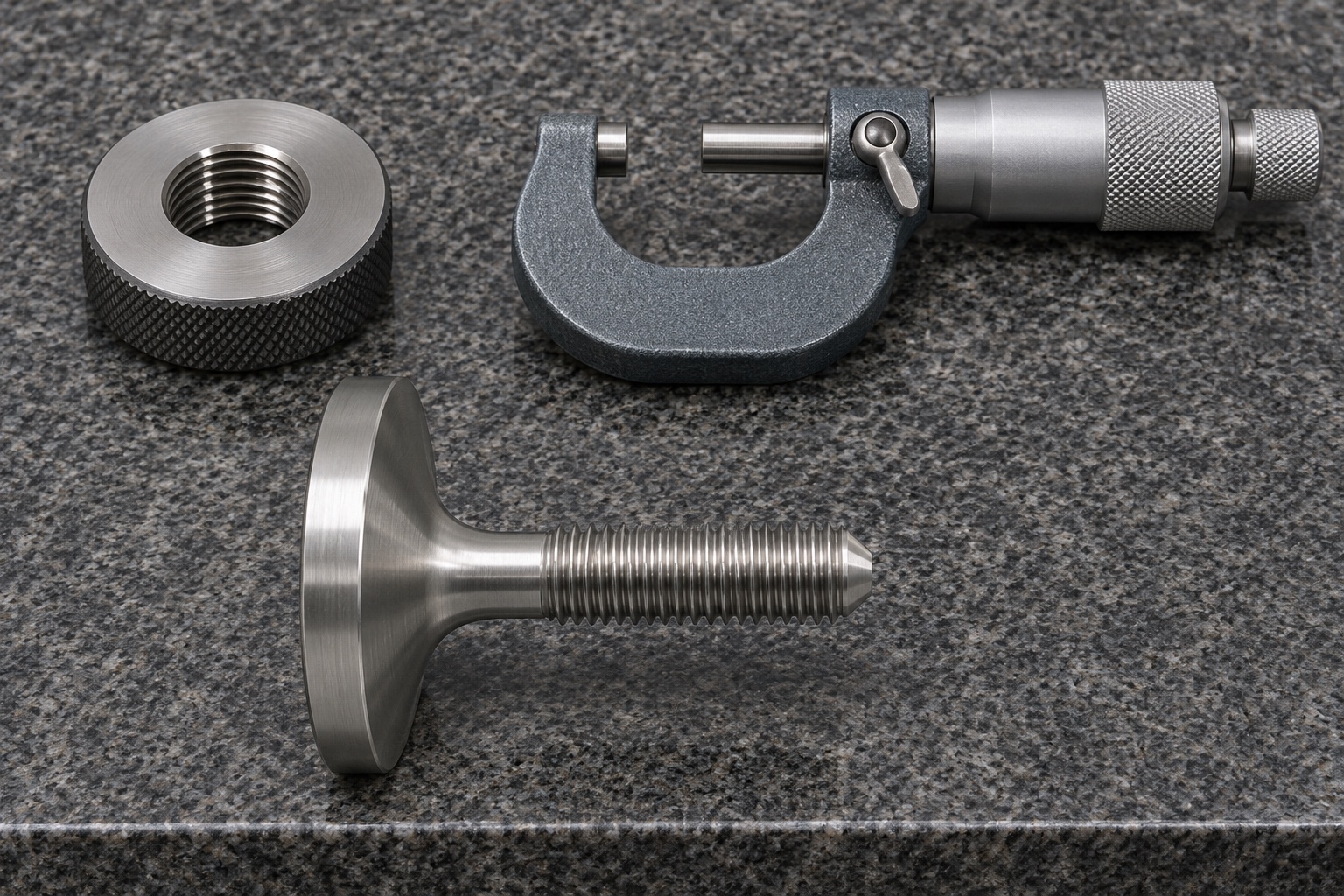
A first-article record would identify material, revision, final condition, setup and actual results. The inspection plan would assign methods to foot size and seating, stem geometry, thread designation, useful thread length and the required relationships. A suitable thread ring gauge would address its defined acceptance question; separate methods would cover features beyond its scope. Photographs show possible equipment and access, not measured compliance. Gauge identity and condition would be recorded when real inspection is performed. Nominal CAD values would not be copied into a result column as if they were measurements.
Supplementary inert assembly observation
With an approved mating reference, the team could observe whether the thread starts as intended, the assembly path is accessible and the foot reaches its defined position without an unintended obstruction. The record would state the reference revision, assembly condition and observed behavior. It would not establish retention under vibration, tightening torque limits, structural safety, basket loading or service life. If the working design requires those functions, additional qualification would be defined by the responsible designer. A favorable hand-fit observation would not override a failed dimensional or thread acceptance requirement.
Outgoing surface and cleaning condition
The order would define whether the supplied condition is simply deburred and cleaned or includes additional approved treatment. Machining residues at the thread root and foot transition deserve explicit attention because they can remain out of a casual top-view inspection. The selected cleaning and verification method would correspond to the actual outgoing requirement. This example reports no residue result and no validated cleaning process. Any later exposure to a wash cycle, disinfectant or sterilization process would need separate compatibility and process review for the material, finish and complete equipment arrangement.
Protective packaging and receiving identification
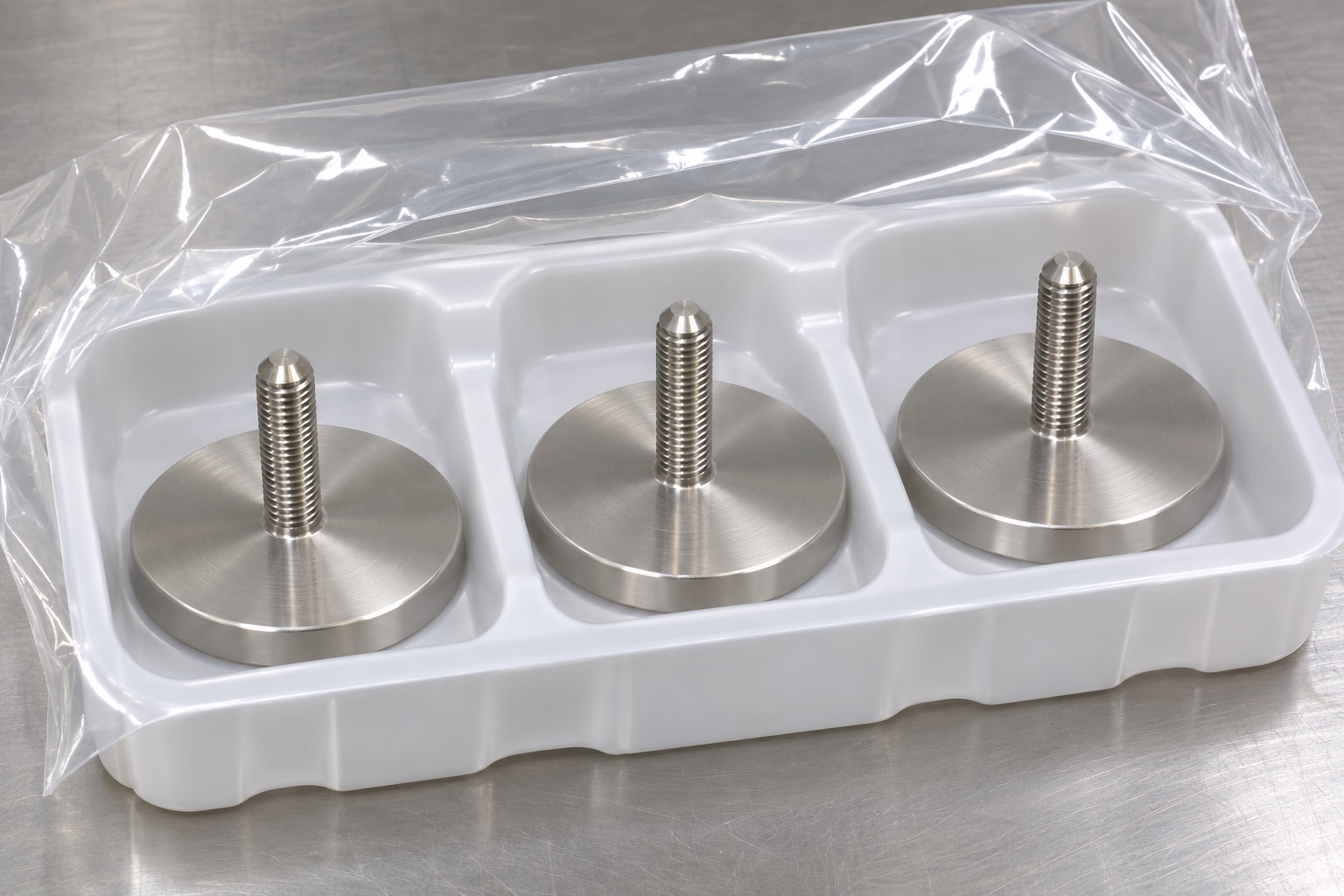
The proposed package would isolate the threaded stems and protect the plain foot underside from contact with adjacent parts. The tray would support the component without forcing the thread against a hard wall. Identification would connect the part to the drawing revision, material and inspection package without covering the seating surface. The receiving instructions would distinguish packaging damage from dimensional acceptance and state whether any outgoing-condition checks must be repeated. An open protective bag or clean tray is not a sterile barrier, validated shipping system or evidence that actual parts have already been delivered.
Release path for a real small-batch order
Before a real small-batch release, the parties would approve the drawing, model, material, thread requirements, final condition, inspection methods and packaging. Open DFM items would include thread-tool withdrawal, underside finishing, protected gripping and gauge reach. Changes after a prototype would be recorded rather than silently carried into production. First-article evidence from real parts would establish what was manufactured and inspected. The case offers a structured scope for custom stainless steel medical fixture components while keeping connection strength, cleaning effectiveness and operating-equipment approval outside unsupported machining claims.
FAQ
Is this an actual wash-basket customer project?
No. It is a representative manufacturing example with proposed geometry and workflow. It does not claim a customer, shipment, measured tolerance, certification or successful use in operating medical equipment.
Which features are included in the proposed stud?
A plain circular disc foot, centered externally threaded stem and chamfered tip are included. There is no hole, hex socket, separate nut, swivel mechanism or rubber contact pad in this proposed geometry.
Would a real inquiry need the mating thread definition?
Yes. Include the complete thread designation, available engagement and intended seating condition. The manufacturer should not infer a compatible interface from a picture or from an unspecified sample nut.
What would a thread gauge inspection establish?
It would establish only the thread acceptance covered by the approved gauge and procedure. It would not independently establish foot geometry, material identity, structural capacity or performance under a wash cycle.
Is the protective package a sterile package?
No. It is a proposed handling and identification arrangement. Sterility, validated cleanliness or shipping protection would require separately defined processes and evidence and are not asserted in this example.
What is needed before repeating the part in a small batch?
Approve the revision, material, thread interface, seating references, manufacturing exceptions, inspection methods and packaging. Preserve real first-article results and manage changes rather than treating this proposed route as production evidence.

tanghangyun@oemach.com