
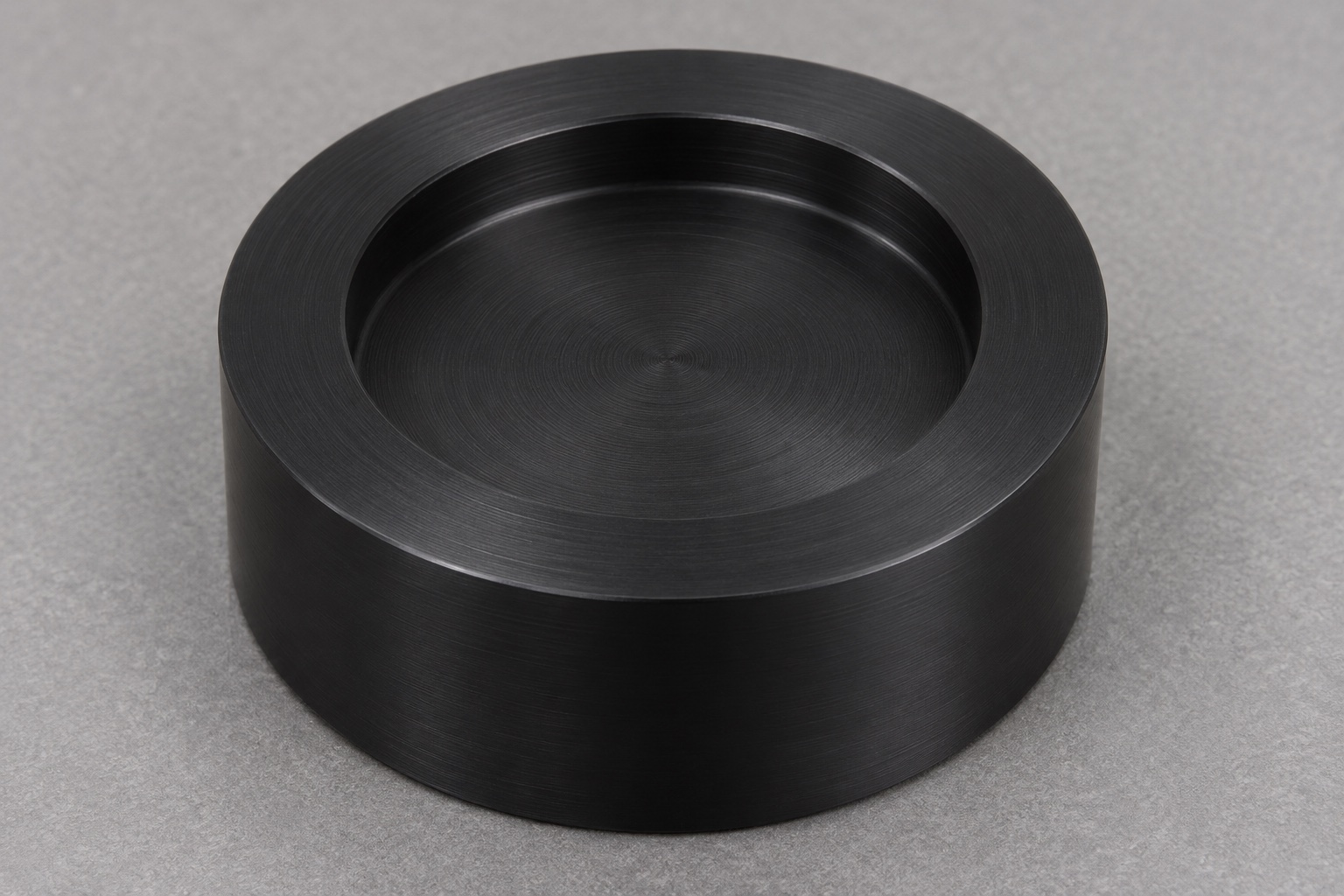
Representative scope of the circular support
This case describes a representative black POM-C support puck for an inert ophthalmic lens blank bench fixture. It is a manufacturing planning example, not a customer shipment, approved optical-contact product or report of achieved results. The geometry is a short solid cylinder with a shallow concentric circular pocket, flat floor and broad annular rim. There are no through-holes, side ports, vacuum grooves or liners. A defined dummy blank would be used for a bounded seating observation without an operating instrument. Real material, dimensions, tolerances and acceptance criteria would have to be approved before the proposal could become a manufacturing instruction.

Resolve which surface supports the dummy blank
The proposed drawing review would request the inert blank's geometry and intended contact area. A circular outside envelope would not be treated as sufficient to establish whether the blank sits on the pocket floor or another specified surface. The design owner would define that relationship and any necessary clearance. If a liner, adhesive or vacuum feature were actually required, the drawing would be revised before quotation and programming. The supplier would not add one informally. This prevents a simple acetal support puck from being presented as a universal fixture for every curved, coated or unfinished optical blank associated with an ophthalmic manufacturing workflow.
Specify POM-C identity before preparing the stock
The hypothetical purchase order would identify the acetal copolymer grade, black color and required stock documentation. POM-H or another black plastic would not be substituted without approval. The supplier would confirm the requested material evidence before accepting a real order, and the blank would remain linked to the traveler and drawing revision. This case claims no certificate or stock lot that has not been documented. The material review would support the proposed turning route without asserting suitability for lens coatings, medical cleaning agents or other application conditions. Those decisions would need separately defined requirements and evidence from the responsible parties rather than visual identification of a dark polymer.
Establish the locating surface and pocket references
The proposed datum scheme would follow the fixture's actual locating interface. If the external cylinder located the puck, the pocket relationship to that surface would be defined accordingly; if another feature controlled location, the inspection setup would reflect that instead. Pocket diameter, depth and floor condition would remain separate requirements. A photograph showing an apparently centered recess would not establish the specified geometry. The review would clarify the bottom seating face and any relationship between that face and the pocket floor. These decisions would be closed before CAM preparation so turning convenience did not become an undocumented substitute for the assembly's intended reference system.
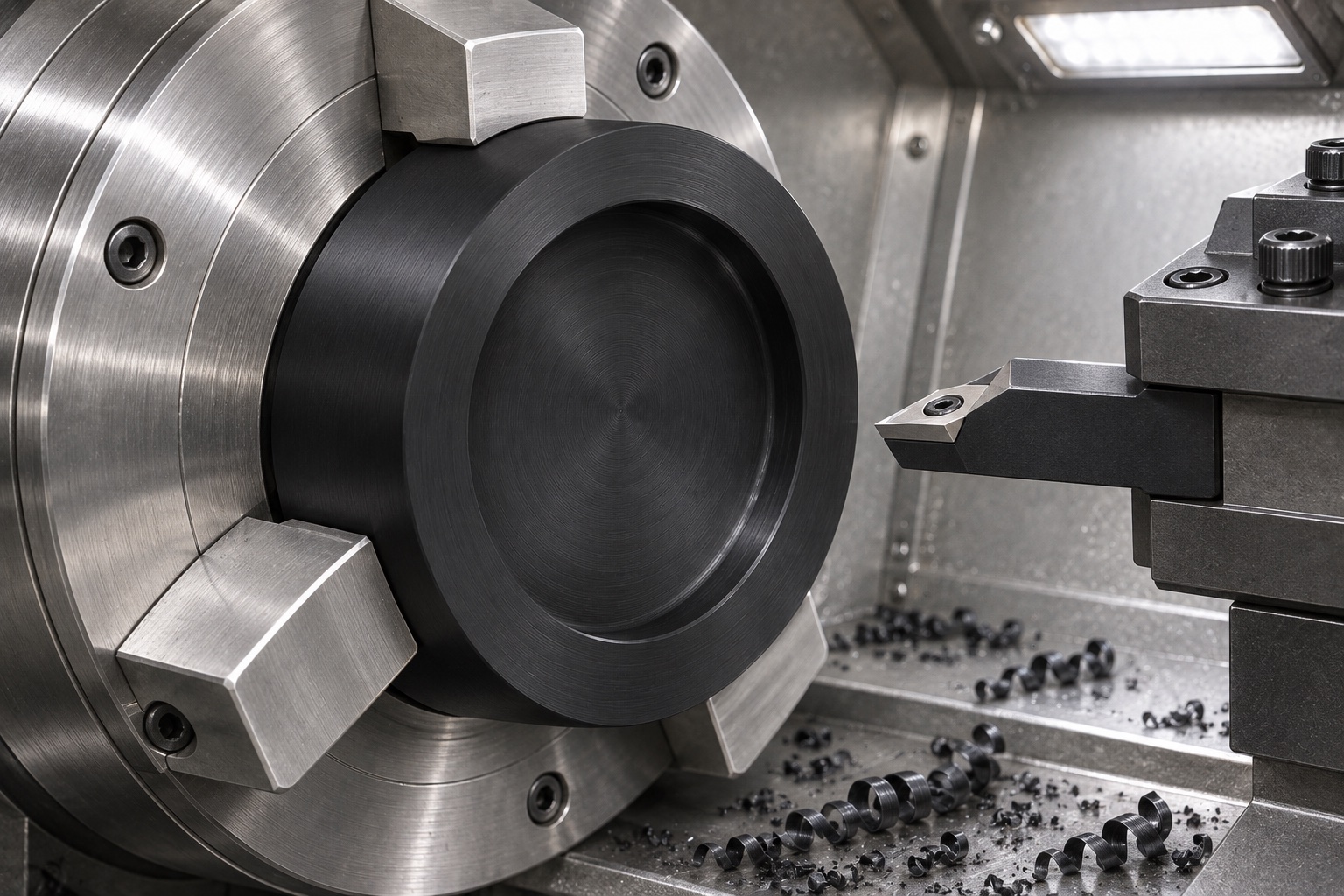
Plan the first turning setup without excessive restraint
The proposed workholding would suit the actual stock and part proportions, with contact areas that kept the pocket accessible. Clamping force would be reviewed to avoid forcing the polymer into a condition that changed after release. The setup sheet would identify support, orientation and the references used for later operations. Finishing stock would remain where the process plan required it. No universal speed, feed or cycle time is supplied by this representative case. The actual route would be selected for the approved material, tool and machine, then documented so a repeat low volume optical fixture order did not inherit a different restraint condition from an improvised setup.
Turn the shallow recess to the approved definition
The finishing route would generate the circular wall, flat floor and specified internal transition as distinct features. Tool access would be checked so the floor could be reached without an unapproved center mark, wall damage or change to the pocket geometry. If the drawing's corner requirement could not be produced by the proposed process, the supplier would seek clarification before cutting. The puck would retain its solid bottom; no central drilling would be introduced as a convenient machining shortcut. Surface appearance would not be described as optical quality unless a real specification and actual verification supported that separate claim for the manufactured component.
Recover the bottom face without damaging the recess
A subsequent operation would finish the bottom seating surface and final thickness while protecting the completed pocket and rim. The plan would explain how the required references were recovered and how contact pressure was controlled. A gripping method that distorted the rim would not be accepted merely because the part looked round while restrained. The final component would be evaluated in the state required by the drawing after release from workholding. Any discrepancy would be investigated against the actual process and measurements rather than corrected by unrecorded hand sanding of the pocket floor, which could alter both depth and the intended dummy-contact relationship.
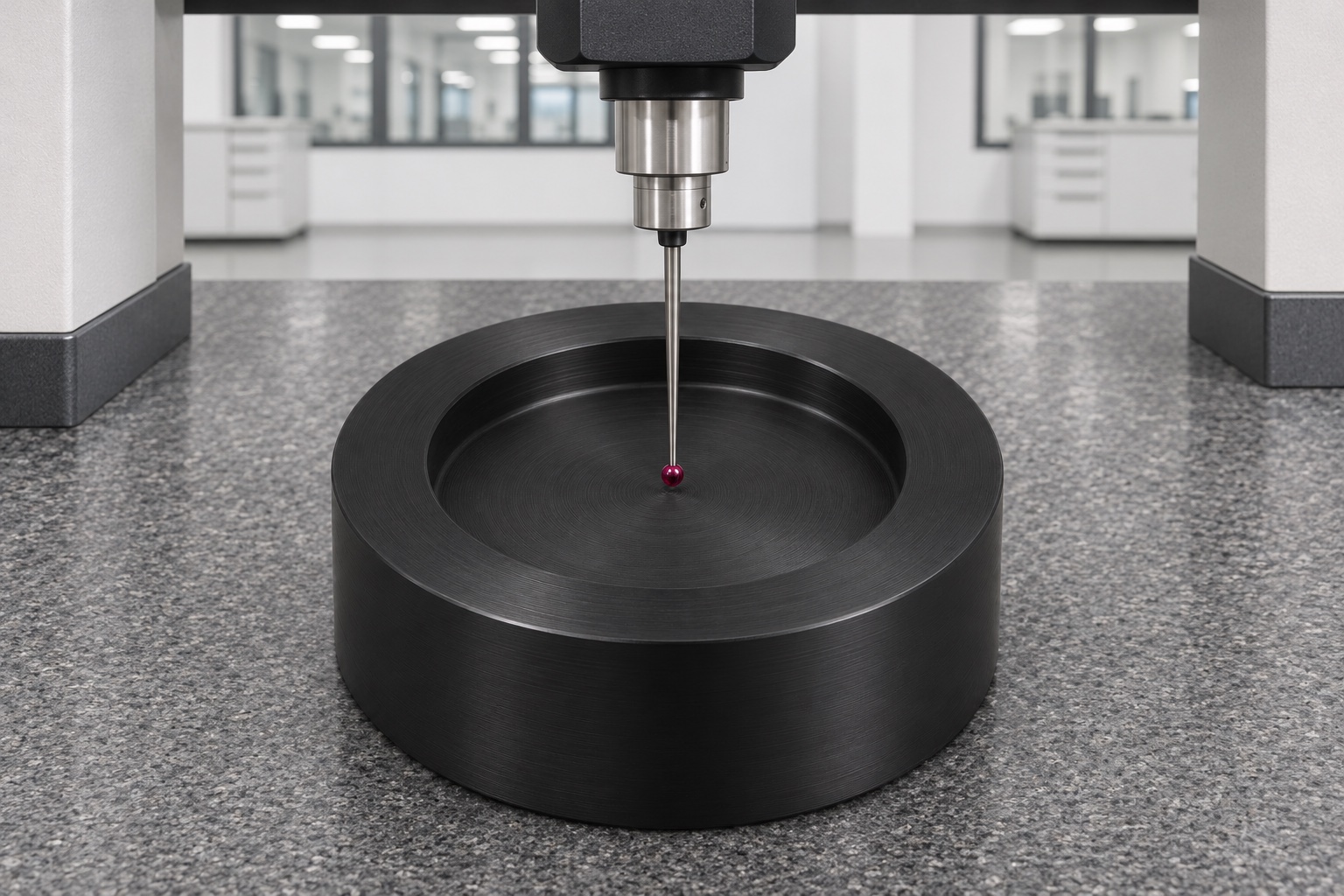
Build an inspection plan for more than one diameter
The proposed first-article matrix would cover pocket diameter, depth, internal transition, floor requirements and the relationship to the locating and seating references. Methods and support would be chosen to avoid excessive contact force on the polymer. The report would record actual readings only after real manufacture and inspection. No achieved tolerance, production yield or capability result is invented here. A diameter reading alone would not establish floor condition or pocket location. Where access or measurement uncertainty limited a proposed check, the supplier would disclose that issue and agree a suitable method before approving the first article or repeating the turning route across a larger batch.
Finish edges without shifting the contact boundary
The proposed traveler would distinguish the pocket-entry edge and external handling edges from the intended support surface. Manual rounding would not be used to hide a dimensional discrepancy or create an unintended annular contact ring. Loose polymer debris would be removed from the floor and transition using an approved procedure. Visual inspection could use agreed magnification where appropriate, but a smooth appearance would remain separate from dimensional evidence. This case makes no claim of scratch-free behavior on real lenses. If the application needed a particular contact quality, its acceptance method would be defined independently before the support puck was evaluated for that real optical handling use.
Limit the seating observation to an identified inert reference
A supplementary bench check could place the defined dummy blank in the inspected pocket without force or powered equipment. The observation would be linked to the dummy's revision and the approved procedure. It could reveal visible interference or seating access, but would not establish optical centration, coating safety or universal compatibility with lens blanks. If rocking or unexpected contact appeared, the team would review the dummy geometry and measured pocket before changing the component. A valuable optical blank would not be used simply because the black acetal surface looked smooth. The limited check would supplement the dimensional report rather than replace it or become a broader application approval.
Agree cleaning and packing without unsupported claims
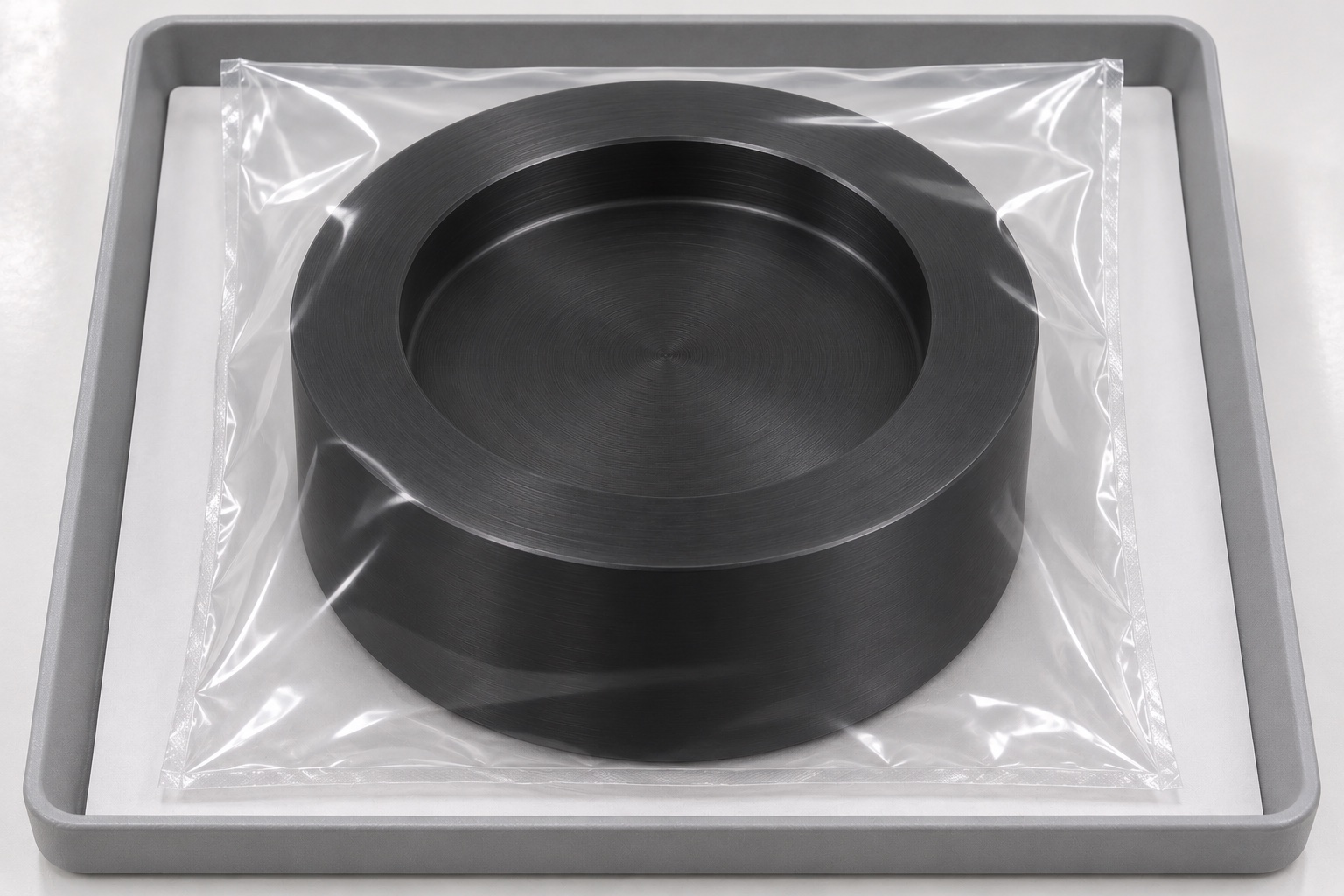
The hypothetical order would define cleaning, drying and final handling suitable for the approved material and inert fixture scope. Ordinary removal of machining debris would not establish a quantified residue level, sterility or validated compatibility with coated optics. Each puck would be separated during packaging so loose hardware or neighboring parts could not rub against the rim or pocket floor. Outer identification would match the actual drawing revision and inspection record. The packaging scene communicates protective handling only, not a completed shipment or validated sterile barrier. Receiving inspection would still check package condition and the requirements written into the real purchase order.
Close the release responsibilities for a real order
Before manufacturing could begin, the buyer and supplier would agree the drawing, POM-C identity, contact definition, reference scheme, inspection and packaging requirements. Actual first-article evidence would then support the release decision. Any extension from an inert dummy fixture to real optical contact or an operating medical instrument would require separate review by the responsible design owner. The representative case provides a structured inquiry for custom POM-C CNC turning without inventing a delivery record. It keeps component machining and measurement distinct from optical and medical application qualification, making the quotation easier to evaluate against a controlled specification and genuine evidence rather than an unsupported product narrative.
FAQ
Is this a real delivered optical support project?
No. It is a representative manufacturing proposal. No customer shipment, approved optical-contact use, certification, measured accuracy or production result is asserted.
What are the main geometric features?
A short solid cylinder, one shallow concentric circular pocket with a flat floor, and a broad annular rim. There are no holes, ports, grooves or liners.
Does the puck use vacuum holding?
No. The representative geometry has a solid bottom and no vacuum features. Such a function would require a separate approved design and acceptance procedure.
Which polymer is specified?
Black POM-C acetal copolymer with the exact grade and stock evidence defined by the actual order. POM-H or another plastic is not an automatic substitute.
Can a good seating observation replace inspection?
No. It is supplementary evidence for one defined inert reference. Pocket geometry and its reference relationships still require the specified dimensional evaluation.
What is needed before manufacturing release?
Approve the drawing and model, material identity, dummy-contact definition, pocket and seating requirements, inspection methods, cleaning procedure and protective packaging instructions.

tanghangyun@oemach.com