
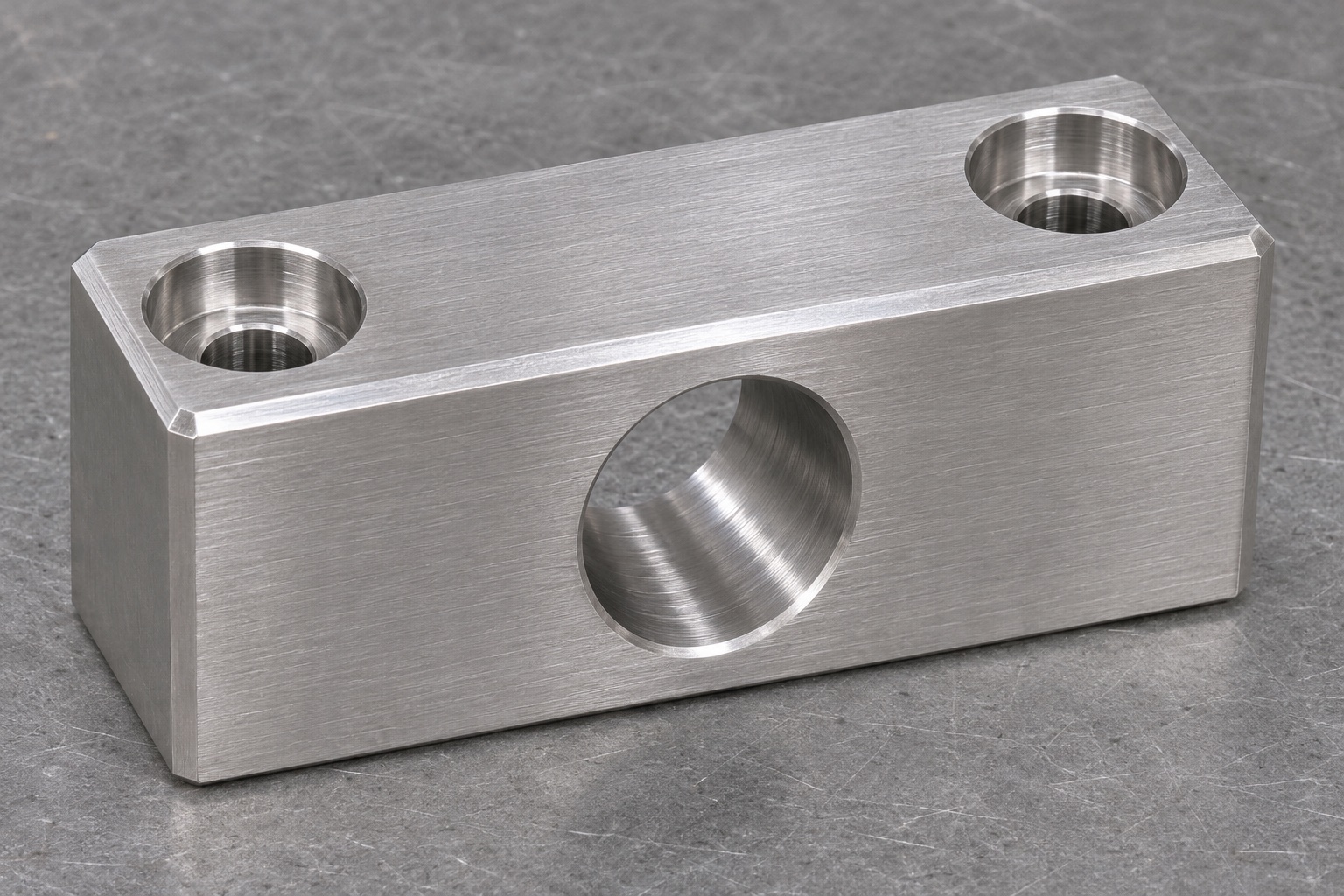
A representative fixture part rather than a delivery claim
This representative machining case describes a possible 316L stainless steel latch pivot block for an unpowered surgical smoke evacuator service fixture. It is a manufacturing planning example, not a report of a customer delivery, device certification or measured performance. The block has a rectangular body, one transverse pin bore and two vertical mounting holes. Its purpose in the example is to locate a removable bench-fixture pivot relative to a support surface. No live filtration, suction circuit or clinical operation is involved. All dimensions, tolerances and acceptance conditions would have to come from an approved project drawing before manufacture could begin.

Translate the assembly need into a controlled drawing
The initial review would request the mating pin definition, mounting-surface geometry and the intended assembly sequence. A three-dimensional model would help identify tool access, but the released drawing would remain responsible for tolerances and inspection requirements. The pin bore and mounting-hole pattern should use an agreed datum system rather than independent dimensions from convenient outer edges. Any discrepancy between drawing and model would stop release until resolved. For a small custom CNC order, this review is still valuable: otherwise a supplier could manufacture a geometrically plausible block while missing the relationship that actually controls the fixture's pivot location.
Assign material and revision traceability before cutting
The proposed job traveler would identify 316L stock, its required documentation and the relevant drawing revision. Cut blanks would stay associated with that identity through preparation, machining and inspection. This case does not claim a particular certificate or imply that one has already been obtained. Instead, the order would specify the required evidence and the supplier would confirm its availability before accepting the work. Unapproved substitutions would not be allowed simply to shorten procurement. Packaging labels and inspection reports would repeat the same part and revision identifiers so the receiving team could distinguish this block from a visually similar fixture component.
Resolve hole layout before creating the CAM program
The two mounting holes would be positioned away from the transverse bore in this representative design. That separation makes the intended geometry clear and avoids treating an accidental hole intersection as an acceptable result. A section review would check screw-head recesses, the remaining body wall and the space required for the pin. If the real assembly demanded different geometry, the drawing would be revised rather than silently adapting the machining program. The supplier would flag any inaccessible edge or measurement area during this review. The goal is an inspectable component, not merely a tool path that can remove material from the model.
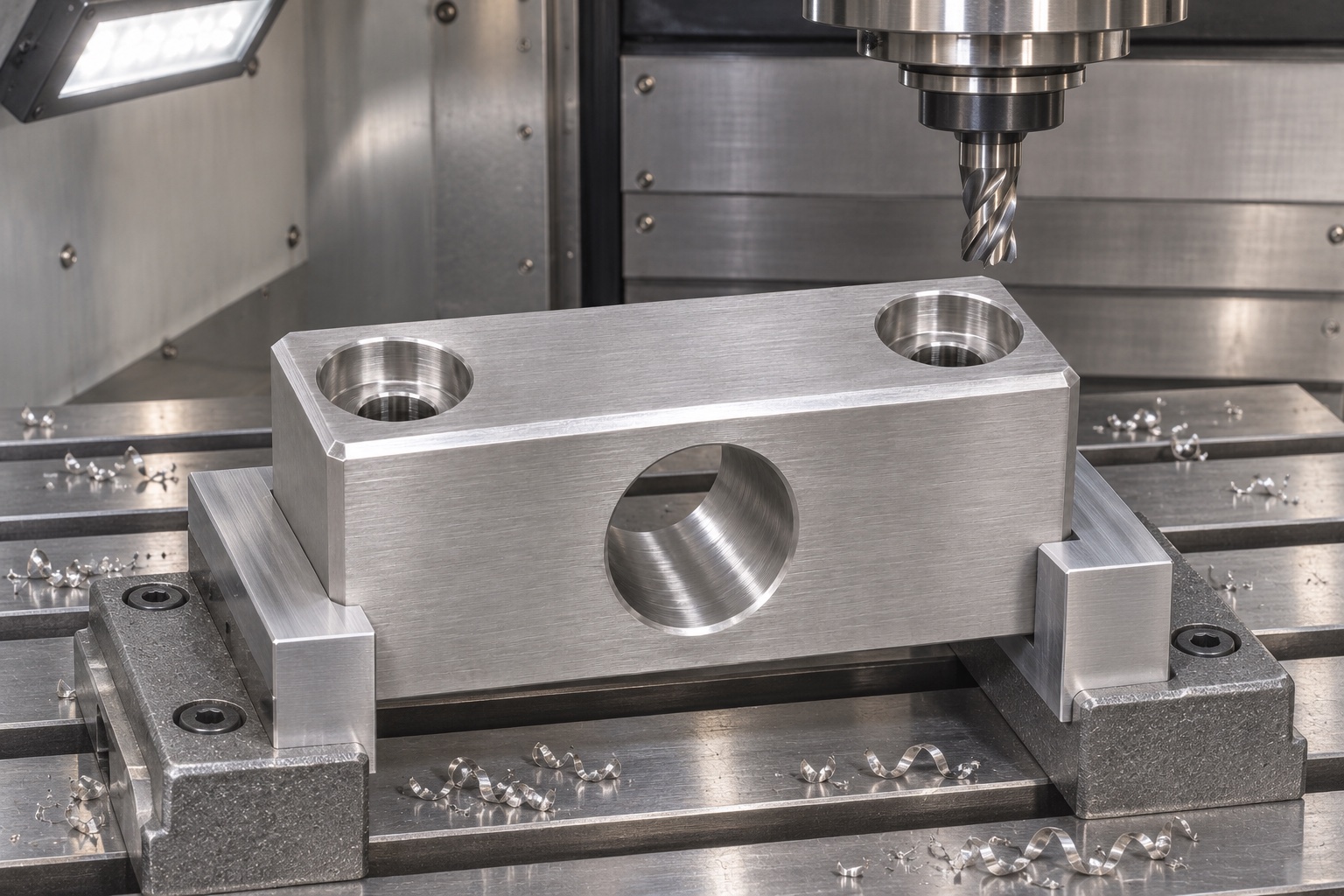
Use the first setup to create useful reference faces
The initial milling operation would establish supported reference surfaces while leaving appropriate finishing stock where the process plan requires it. Clamping would act on areas that do not obstruct the cutter or damage the final functional faces. The setup sheet would identify the supported face and the orientation used to locate subsequent features. Tool lengths, approach paths and fixture clearance would be checked before cutting. This representative route does not prescribe a universal speed or feed for 316L; actual settings would be selected and verified for the machine, tools and stock involved. Setup repeatability would be documented rather than inferred from machine branding.
Recover the same references for the pivot bore
A second orientation would present the transverse bore to the tool while recovering the defined mounting references. The process might use a pilot followed by a suitable finishing operation, depending on the released requirements. Bore diameter alone would not be treated as the complete acceptance condition. Its location and direction relative to the mounting surface would remain separate inspection items. Any workholding change that altered the reference strategy would require review before proceeding. The representative case therefore emphasizes a controlled relationship between setups, rather than claiming that one particular cutting operation can automatically produce every required aspect of the finished pivot interface.
Manage mounting recesses and edges as specified features
The mounting holes and any approved counterbores would be machined to their drawing definitions. A screw head that appears flush in a photograph would not establish acceptable recess depth or remaining wall thickness. Bore entrances and hole exits would receive the specified edge treatment without uncontrolled hand blending of bearing surfaces. The traveler would include a check for loose chips and accessible edge defects. Where an edge could not be inspected with the proposed method, the plan would identify an alternative or seek clarification. This approach keeps finishing work measurable and prevents a general instruction to deburr from hiding a changed functional interface.
Plan the first-article report without invented results
The proposed first-article report would list the critical bore, mounting pattern and reference-face requirements with their selected measurement methods. It would distinguish directly measured dimensions from visual checks and assembly observations. No numeric results, yield percentage or process capability is claimed here because this is not a completed production lot. A real report would record actual measurements, instrument identification and the drawing revision used. If a feature could not be evaluated credibly, shipment approval would wait for resolution. The case demonstrates how to organize evidence for a precision stainless steel milling order, not how to substitute nominal values for inspection data.
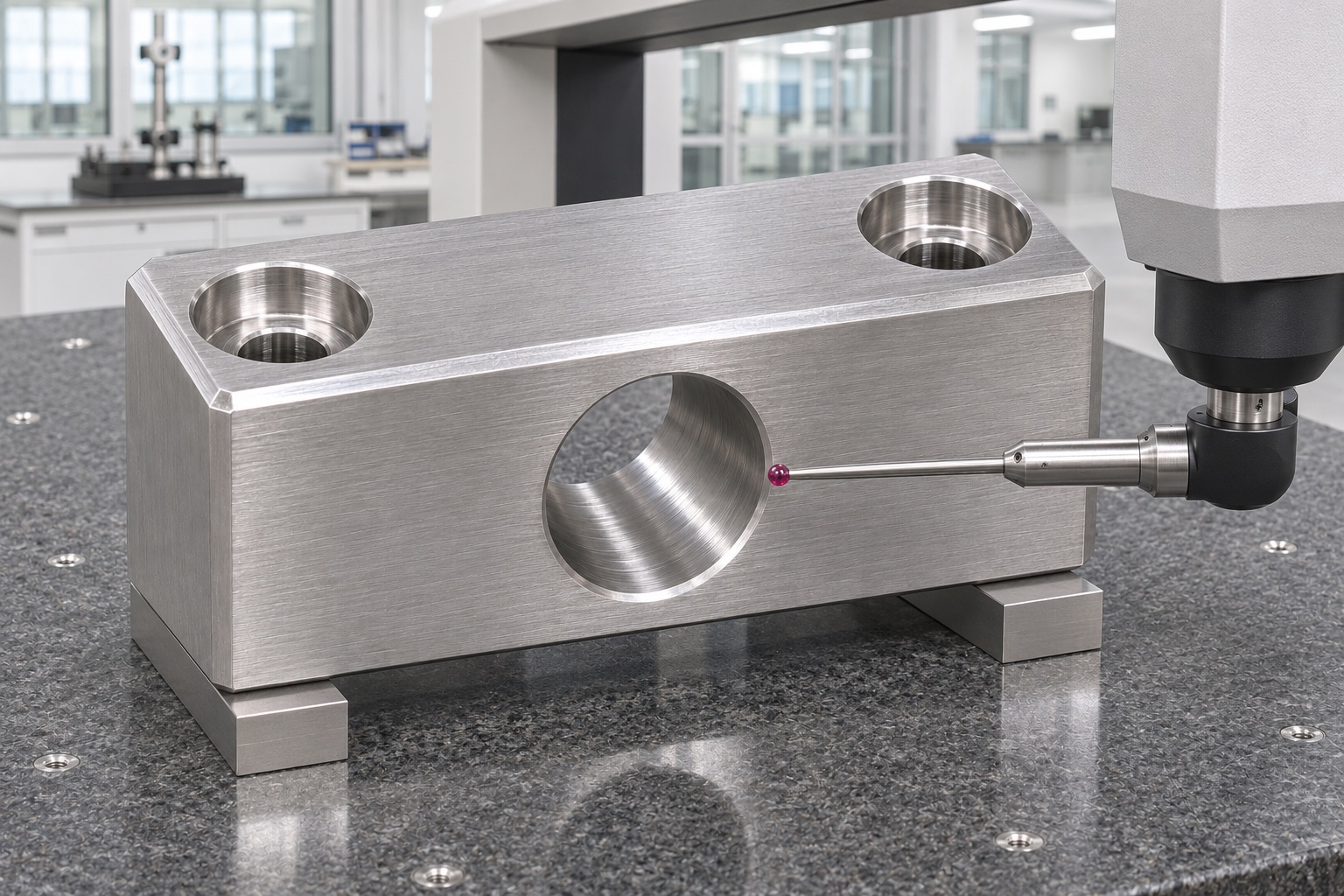
Use an inert mating check as supplementary evidence
A removable reference pin and an unpowered fixture plate could support an agreed bench assembly check after dimensional inspection. The check would observe seating and assembly access without implying load capacity, service life or compatibility with an operating device. The pin would not be forced through a suspect bore, and fasteners would follow the fixture's approved assembly instructions. Any observation would be recorded as a bench-fit observation, separate from the dimensional report. If the fixture could conceal a geometric error by elastic movement or excessive clearance, that limitation would be noted instead of presenting a successful assembly as universal proof of conformity.
Establish the outgoing cleaning condition explicitly
The hypothetical order would define the permitted cleaning and drying process before final handling. Loose machining debris would be removed, and the bore would be checked for trapped chips using an agreed accessible method. This does not establish sterility, biological compatibility or a quantified residue limit. Those claims would require separately specified evidence and appropriate review. If a surface treatment were requested, its effect on the finished interfaces and the sequence of final inspection would also need approval. Clear instructions are especially important for small medical equipment fixture parts, where an informal final wipe can otherwise become an undocumented substitute for a manufacturing requirement.
Keep the inspected component isolated during packing
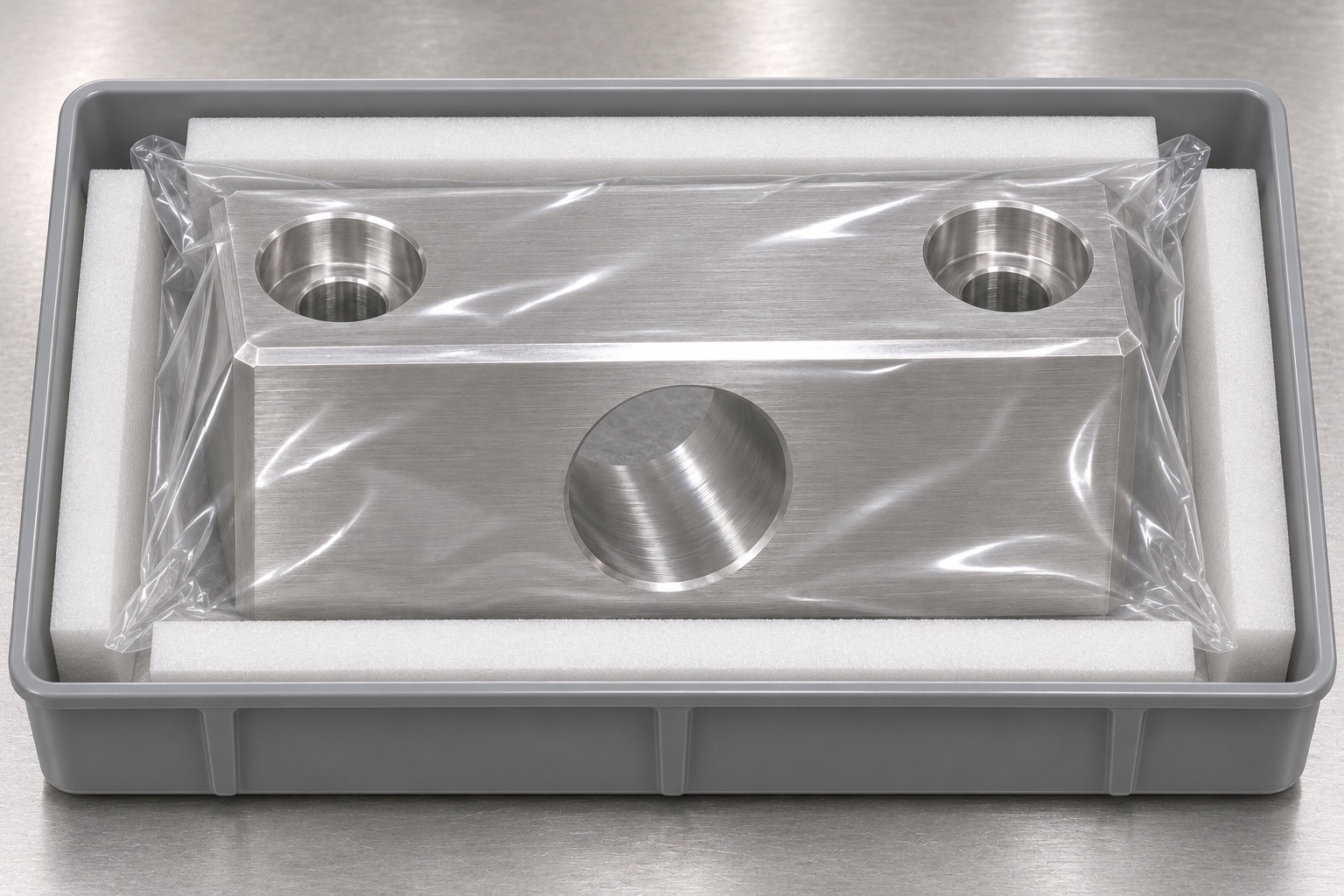
The proposed packaging would protect the bore entrances and mounting references from rubbing against other metal components. Each block would be individually contained with its part number and revision identified outside the contact surfaces. Any protective insert would be selected to avoid shedding or loading the bore. Inspection documents would stay linked to the package identity, without adding unsupported cleanliness or certification statements to the label. The packaging scene associated with this case represents protective handling only. It is not evidence of a validated sterile barrier, completed shipment or a particular customer's packaging specification. Receiving inspection would follow the actual purchase order.
Define what a real release decision would require
Before this representative block could become a real order, the buyer and supplier would close all open drawing questions, confirm material evidence and approve the inspection and packaging plan. Manufacturing release would be followed by actual measurement and review, not by copying the example's proposed workflow into a completed-results statement. Any use beyond an inert fixture would return to the responsible design owner for evaluation. A clear RFQ can therefore ask for custom 316L CNC parts, bore-to-mounting control and traceable low volume machining without implying a medical-device approval that the manufacturing example does not provide. The distinction protects both technical accuracy and purchasing clarity.
FAQ
Was this block delivered to a named customer?
No. It is a representative planning case with no asserted customer, delivery record, measured results or certification. Actual orders require independent documentation.
What is the main functional relationship?
The transverse pin bore must be located and oriented relative to the defined mounting references and mounting-hole pattern, as specified by the released drawing.
Is the proposed fixture powered during the fit check?
No. The example uses only an inert reference pin and an unpowered fixture. It makes no claim about filtration, suction performance or clinical operation.
Why are numeric inspection results absent?
No real production lot is being reported. A genuine first-article report must contain actual measurements and identified methods rather than invented example values.
Can 316L documentation establish finished-part approval?
Material documentation supports material identity. It does not independently approve the completed geometry, cleaning condition, assembly use or compatibility with operating medical equipment.
What starts a real manufacturing quotation?
An approved drawing and matching model, quantity, material requirements, fixture scope, critical interfaces, inspection deliverables, cleaning process and protective packaging instructions are needed.

tanghangyun@oemach.com