
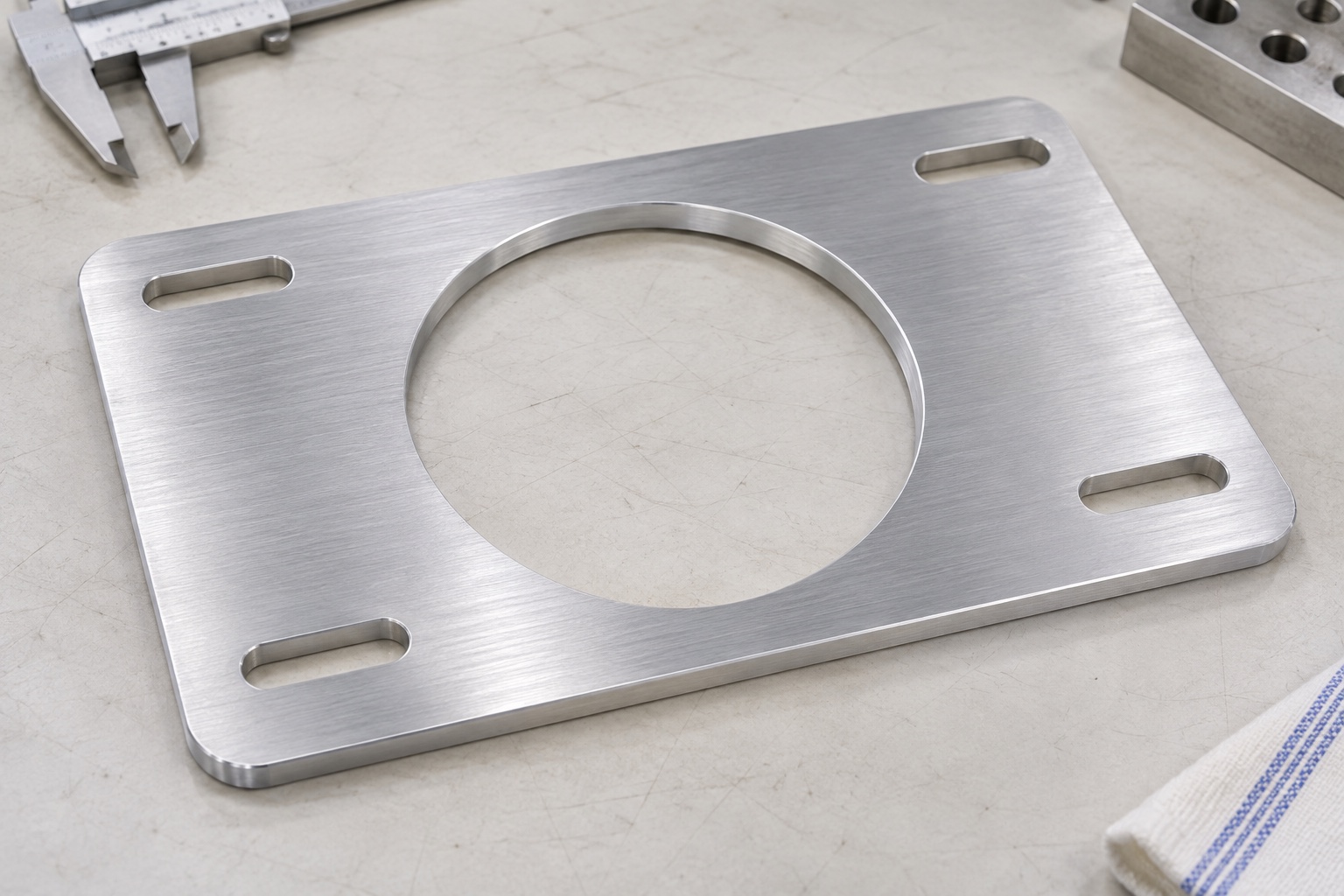
Representative plate and scope of the example
This representative medical CNC milling case considers a 6061 blower mounting plate for a patient warming unit context. It is not a named customer delivery, a certified replacement or a tested warming system. No achieved tolerances, airflow, temperature-control results or patient outcomes are claimed. The geometry is a rectangular plate with a central circular opening and four external mounting slots. The example explains how a supplier could plan manufacture and inspection after receiving approved requirements. Blower selection, electrical work, assembly instructions and device qualification remain separate from acceptance of the plate against its controlled mechanical definition.

Reconcile files and acceptance conditions
For a real project, drawing and model revisions would be checked together before selecting stock or fixtures. The supplier would request missing definitions of seating contacts, opening role, slot geometry and the required inspection state. A visual similarity to another blower plate would not authorize an assumed mounting interface. The quotation would identify material, quantity, final finish and inspection evidence rather than omit difficult relationships behind a general precision claim. Later design changes would follow a controlled revision so procurement, machining and inspection continue to refer to the same component rather than a mix of earlier and later interface definitions.
Establish the seating references
The proposed drawing review would identify useful seating regions and distinguish them from areas that do not contact the approved mount. Thickness would be treated separately from form and any required relationship between faces. The supplier would clarify whether the part is accepted free or in a specified mounted condition. If mounting hardware influences the definition, approved details would be provided. An arbitrary fixture that pulls the plate flat would not become the acceptance reference. The inspection plan would address the intended geometry rather than report a favourable condition produced by an unrecorded support or tightening arrangement.
Define the opening and slot interfaces
The central circular opening would be identified as locating or clearance geometry according to the controlled design. Its size and position would be separated from the mounting-slot pattern. The supplier would review useful slot length, width, orientation and end conditions, along with the approved neighbouring envelope. A bolt passing through one slot would not establish the whole interface. This example does not choose an aperture for airflow or prescribe an adjustable mounting position. Those decisions belong to the responsible design. Manufacturing would work from the approved mechanical definition rather than infer a complete warming subsystem from the plate outline.
Confirm material identity and treatment scope
The specified 6061 condition, stock form and document requirements would be confirmed before a real material release. Identity would remain linked to the drawing revision and production record. Any proposed substitute would need approval. Anodizing, another treatment or marking would have a controlled scope and an explicit final acceptance state. The case does not infer electrical insulation, corrosion-test performance or cleaning compatibility from a finish name. The supplier would distinguish actual material documents from dimensional evidence and device-level qualification. A measurement made before treatment would not automatically be reused for a requirement that applies only to the finished plate afterward.
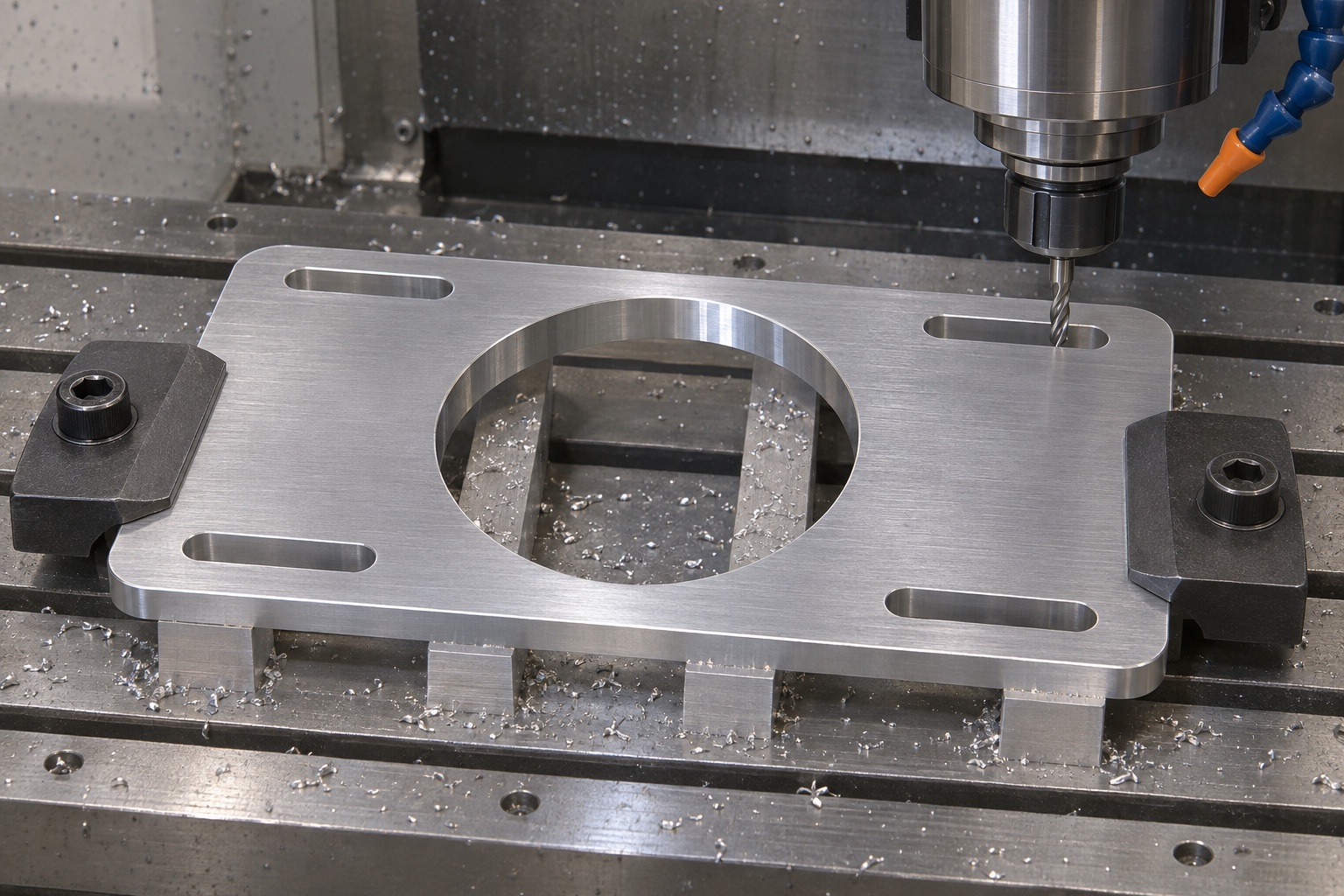
Plan a supported milling sequence
The representative route would consider how to produce the faces, central opening and mounting slots while retaining support around the remaining webs. Actual dimensions, blank and equipment would determine the sequence. No universal feeds, speeds or thermal treatment are asserted. The supplier would identify which reference surfaces become available at each stage and how they are protected during later work. Removing the central section changes support possibilities, so fixture access would be reviewed before production rather than improvised afterward. A convenient route would still need final evidence for the accepted plate after operations that can influence seating and mounting relationships.
Recover references without forcing the plate
Any reversal or secondary fixture would recover the approved datums and avoid treating clamp-induced shape as proof of conformity. The plan would distinguish machining support from final acceptance support. If mounted inspection were required, its approved hardware and condition would be reproduced deliberately. A difference between constrained and released observations would prompt review before corrective cutting. The supplier would not remove additional material simply because a different fixture produced a different reading. This keeps the process focused on a reproducible component against controlled requirements rather than a passing measurement obtained by tightening, shifting or restraining the plate until the desired observation appears.
Finish edges and establish the final state
Edge finishing would cover the central opening, slot ends, mounting contacts and perimeter. Useful slot travel and seating regions would be preserved. The route would identify features needing reinspection after edge work or approved treatment. Loose material would be removed before interface trials, but ordinary chip removal would not be described as validated cleaning. The case makes no claim of sterile delivery. Marking and protective handling would preserve useful contacts rather than obscure them. A real acceptance record would identify the actual final state and performed operations instead of combining measurements from before and after treatment as though nothing had changed.
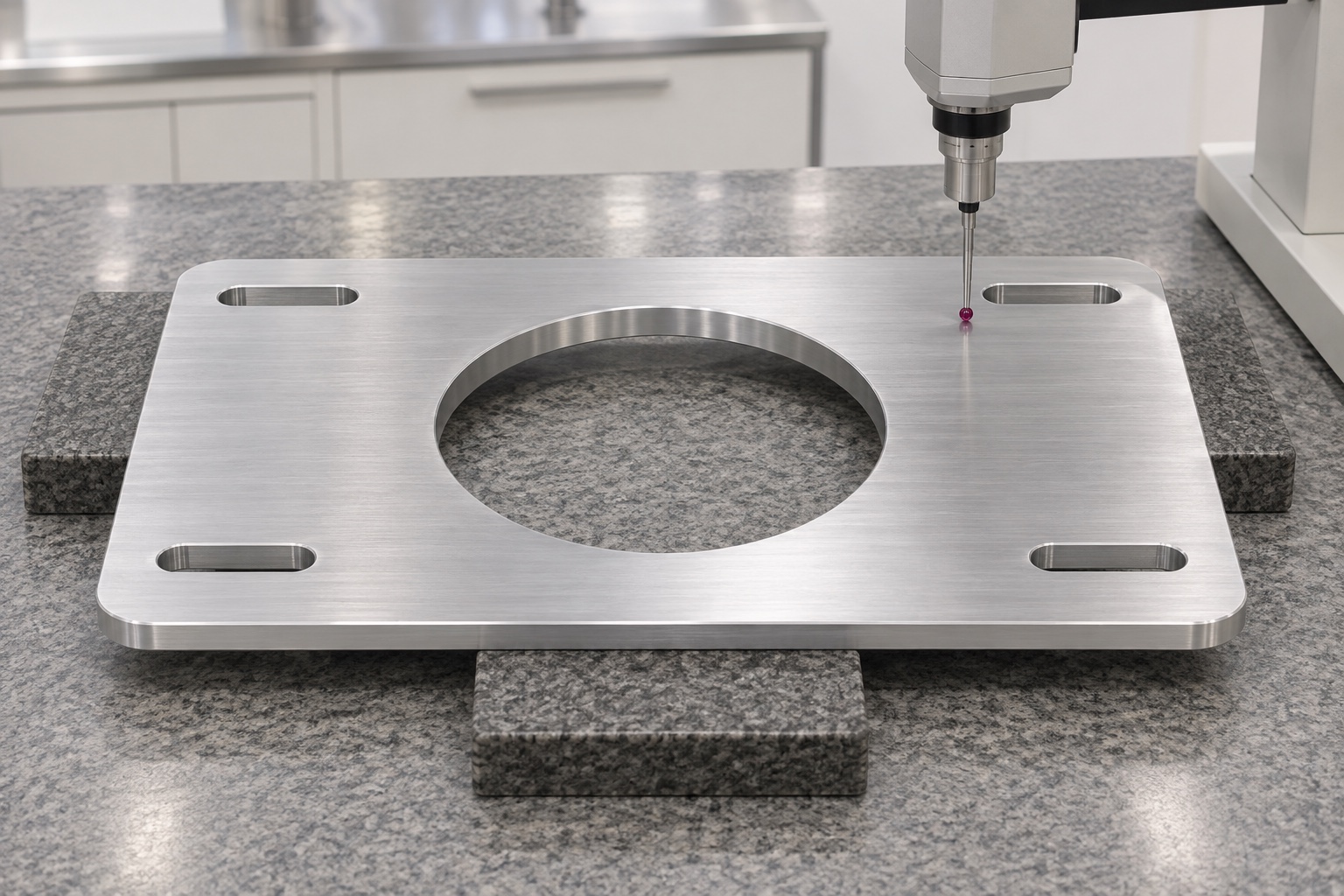
Define a characteristic-based inspection package
The example matrix would separate thickness, useful seating form, opening size and position, slot dimensions and mounting-pattern relationships. Each requirement would have a suitable method, reference and part state. Coordinate, optical or contact measurements would need access to the actual feature and a documented scope. A real report would identify parts, instruments, revision and measured results against approved limits. This case includes no fabricated inspection table. If a proposed method could not evaluate a required region, that limitation would be resolved before production rather than hidden behind a broad statement that every plate was checked on precision equipment.
Consider a hypothetical rocking interface
Suppose an identified inert blower-shaped reference rocked or contacted the central opening unexpectedly. This is a diagnostic scenario, not a reported manufacturing result. The supplier would preserve the observation and review seating regions, reference alignment, slot definition, support and edge conditions. Enlarging all slots would not be the automatic response. A manufacturing deviation would require an authorized disposition; incomplete interface information would require clarification or revision. After approved correction, affected characteristics would be inspected again in the defined final state. Reference identity and support would remain recorded so a changed spacer or tightening condition is not silently treated as equivalent evidence.
Separate mounting evidence from warming-system tests
An inert interface comparison could document contact and clearance without installing electrical equipment or operating a patient warming unit. It could not establish airflow, noise, vibration isolation, temperature control, electrical safety or patient outcomes. The responsible device organization would define and evaluate those requirements separately. A supplier's component report would not approve a replacement for a named commercial system. This boundary keeps a representative manufacturing case useful for procurement without turning a limited fit observation into a medical performance claim. Actual evidence would describe what was measured and observed, along with the specific limitations of the selected methods and references.
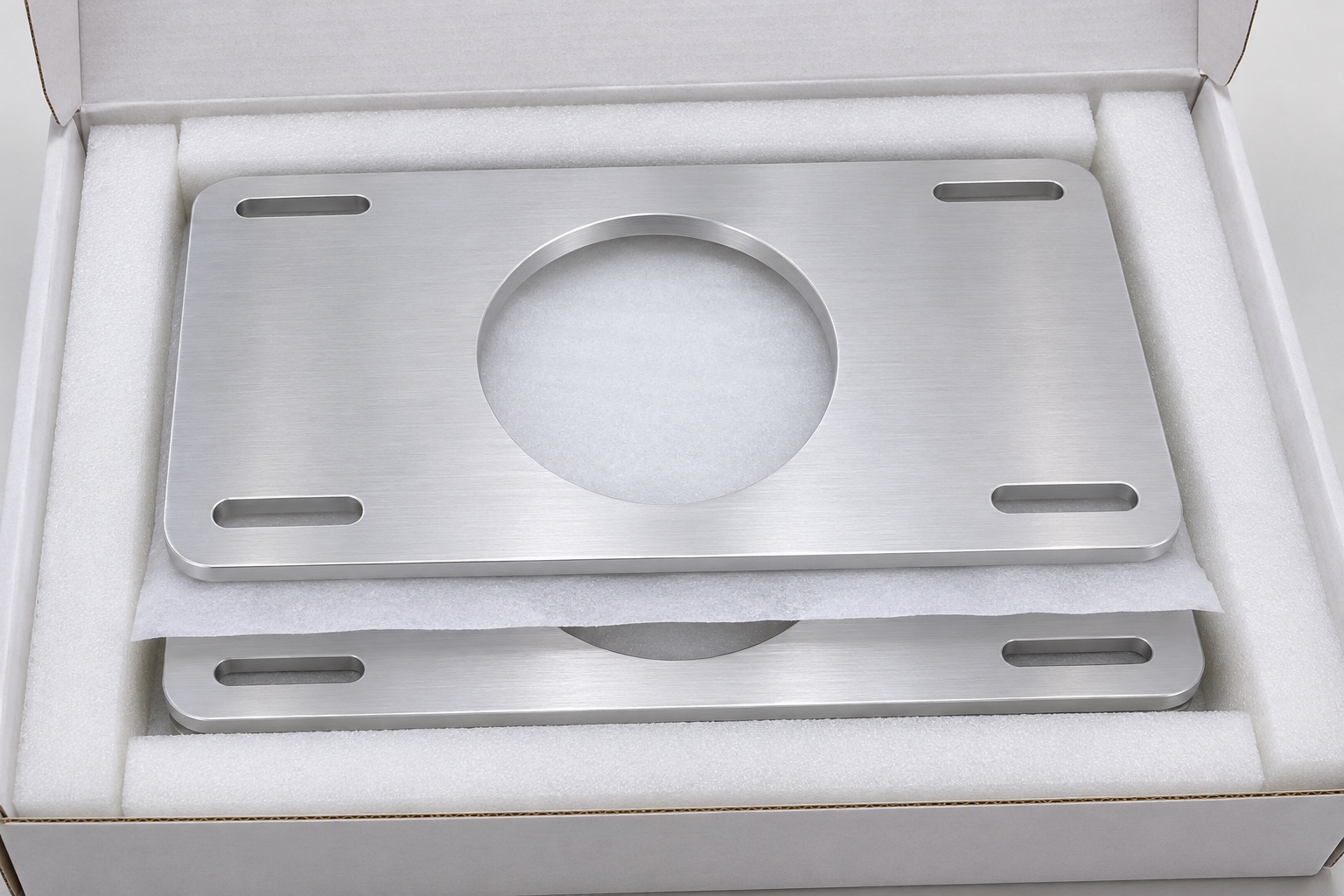
Protect the plate and prepare an actual order
For transport, individual separation would prevent edges and seating faces from striking neighbouring metal parts. Supports would avoid bending remaining webs or leaving packing fragments in the slots. Part identity, revision and inspection records would remain associated with the shipment. A real enquiry would include controlled files, material condition, quantity, seating and opening definitions, slot pattern, mating envelope, final treatment, inspection scope and protective packaging. This representative route offers a concrete framework for a medical equipment machining discussion without implying that a customer delivery, tolerance achievement, blower-performance test or completed qualification of a patient warming device has already occurred.
FAQ
Does this case describe a tested warming-system delivery?
No. It is a representative component manufacturing example with no named shipment, measured tolerance, airflow result, temperature-control outcome or device qualification claim.
Why inspect seating form separately from thickness?
Thickness readings do not establish the shape of the useful contact regions. The approved drawing must define the relevant form and inspection state.
Can the supplier choose the central opening from a blower photograph?
No. Its role, size, position and neighbouring clearance must come from the approved mechanical definition, not be inferred from an application image.
What would happen after a hypothetical rocking trial?
Preserve the observation and review contacts, support, edges and reference alignment. Obtain the required authorization before correction, then recheck the affected characteristics.
Does a passing mounting trial prove thermal performance?
No. It records limited mechanical geometry, not airflow, temperature control, noise, electrical safety or performance of the complete patient warming system.
What is needed before actual production?
Approve consistent files, material, quantity, final state, seating and opening geometry, slot pattern, mating references, inspection requirements and protective packaging.

tanghangyun@oemach.com