
Describe a component example rather than a delivery
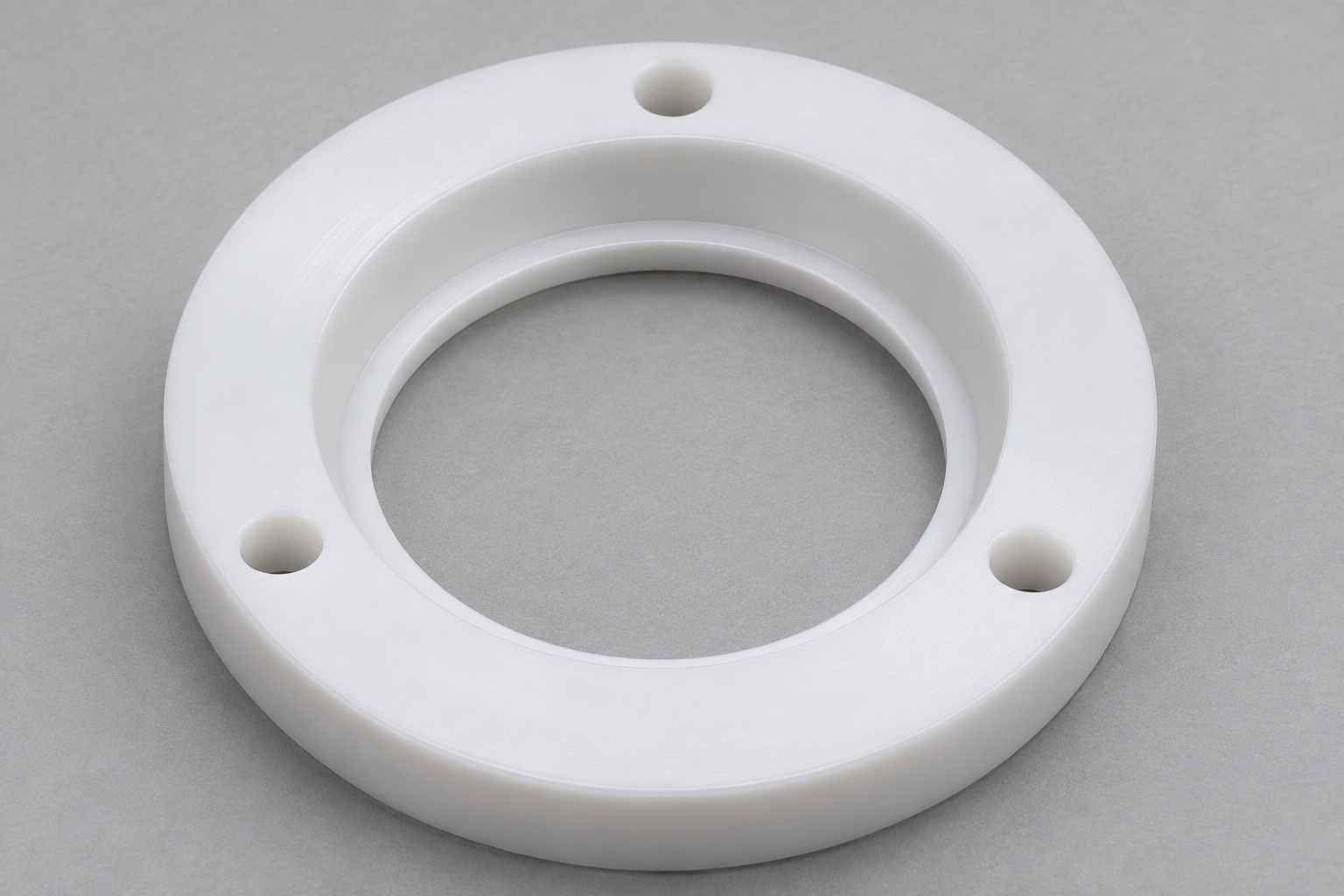
This representative precision CNC case concerns a POM-C trackball retaining ring in the application context of an ultrasound console. It is not a report of a delivered customer order, an approved spare part or a tested console. No certification, measured result, wear performance or input accuracy is claimed. The example shows how a controlled manufacturing package could define a stepped opening, an inner lip, a seating flange and mounting features. A real project must provide approved dimensions and acceptance criteria. Evaluation of the complete trackball and medical system remains separate from the supplier's dimensional evidence about a single machined polymer component.

Assign functions to the ring geometry
The considered ring has a broad flange surrounding a stepped central opening and a defined inner lip. The mounting pattern connects it to a separately specified housing. The drawing must identify which surfaces locate, support or provide clearance. A larger internal diameter and a smaller visible opening do not automatically explain the intended contact. Any curved profile or local relief needs explicit definition. The representative shape is not a universal replacement for an existing console part. Identifying surface roles gives the supplier an inspectable component definition without an operating trackball and avoids assuming that every visible edge is meant to retain or touch the mating reference.
Establish real quotation inputs
An actual inquiry would supply matching drawing and model revisions, exact POM-C grade, quantity, material-document requirements and final surface condition. The approved housing and mating envelope are useful when they define lip contact or mounting space. The buyer should also specify acceptance state, inspection evidence and protective packaging. A photograph of an existing ring is not enough to assign tolerances or decide which profile is functional. Separating machining from assembly performance makes the scope comparable across suppliers. Open questions about lip width, reference surfaces or later cleaning should be resolved before ordering instead of becoming undocumented assumptions in a first production attempt.
Review the opening and lip profile
The proposed design review separates visible opening size, larger internal step, useful lip width and axial position. Tool access and permitted transition geometry are checked against those features. A proposed chamfer or relief requires approval if it changes contact or usable material. The supplier should not smooth the opening until an unidentified sample appears to move freely. That action might change the intended profile while obscuring the cause of interference. This case describes planning only and does not assert that a specific tool or setup has already produced accepted rings. The actual route must be evaluated for the defined dimensions and available equipment.
Confirm polymer identity and condition
For a real order, incoming material would be checked against the requested grade and traceability scope. A similar white plastic or another acetal grade is not automatically equivalent to POM-C. Any storage, conditioning, surface or cleaning requirement is specified where it affects acceptance. This example does not provide a material certificate or claim resistance to a particular medical cleaning process. It explains where evidence would be requested and linked to manufactured parts. The word medical does not create an approval absent from the requirements. Changes to material or final state should remain associated with controlled revisions so later inspections are not compared under unrecognized differences.
Plan the ring-making operations
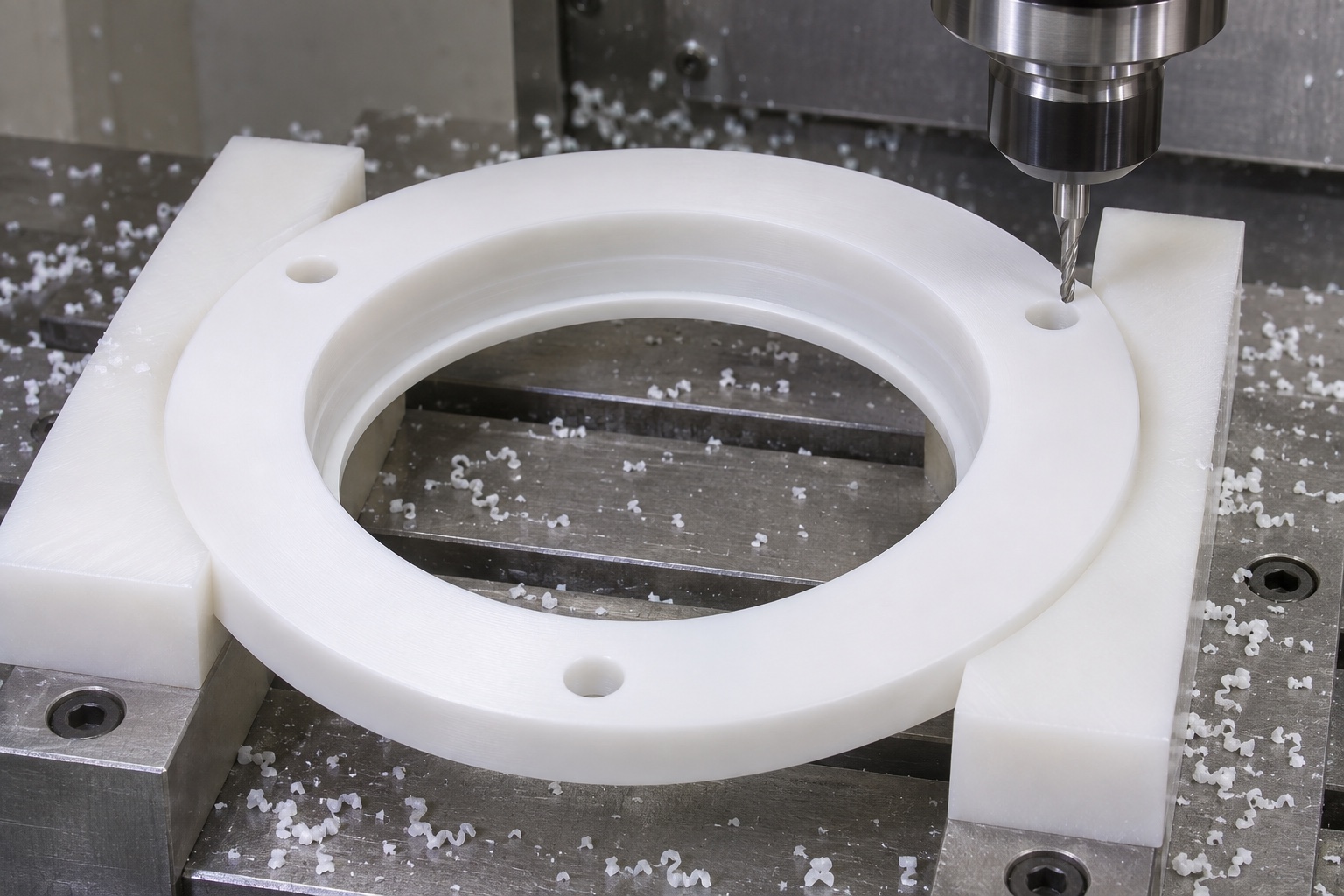
The proposed route considers the large opening, stepped section and flange support before selecting turning or milling operations. Removing the center changes the material available for later workholding. The process plan should say which references are established first, how they are recovered and which operations could affect finished surfaces. No universal feeds, cycle time or capability are claimed for this representative part. The actual blank and machine matter. If the ring is transferred to machine its mounting pattern, the new support must not distort the flange or erase the relationship to the functional opening. Reducing setups is useful only when the required relationships remain verifiable.
Locate the mounting pattern relative to the opening
Mounting features are positioned according to the approved functional references. Individual hole diameters alone do not verify their relation to the opening or the housing seat. If recesses are present, their contact regions and remaining sections also need definition. The hardware and any assembled-state requirement belong to the device definition. A passing screw trial does not establish ring location or an acceptable tightening condition. The planning review checks access for cutting, finishing and inspection. This gives the supplier a defined geometric task instead of relying on available screws to pull the flange into alignment with an unidentified console housing.
Separate manufacturing restraint from inspection state
The proposed workholding review identifies contact areas that support the flange without changing the measured lip or opening unnecessarily. A polymer ring held flat against a fixture may not represent its released condition. If acceptance is defined in a mounted state, that state needs an approved reproducible setup rather than arbitrary clamp force. This representative case contains no measurements under either condition. It emphasizes why differing readings should first trigger a reference and support review. A change in fixture, hardware or contact force can affect the observation, so corrective material removal should not begin until the actual source of the discrepancy is understood and documented.
Finish transitions without changing the working lip
Loose material can remain at the opening, step, mounting holes and recesses. The agreed finishing method removes it without rounding away a useful lip band or changing its axial location. Features affected by finishing need appropriate reinspection. A clean exterior does not demonstrate the condition of every internal transition. Inspection access is resolved before production, not after a trial reference is forced through the opening. Ordinary chip removal and protective handling are not claimed as sterile preparation. Any special cleanliness process must have its own specified acceptance and evidence, separate from the report on the geometry of this medical console component.
Plan evidence from identifiable parts
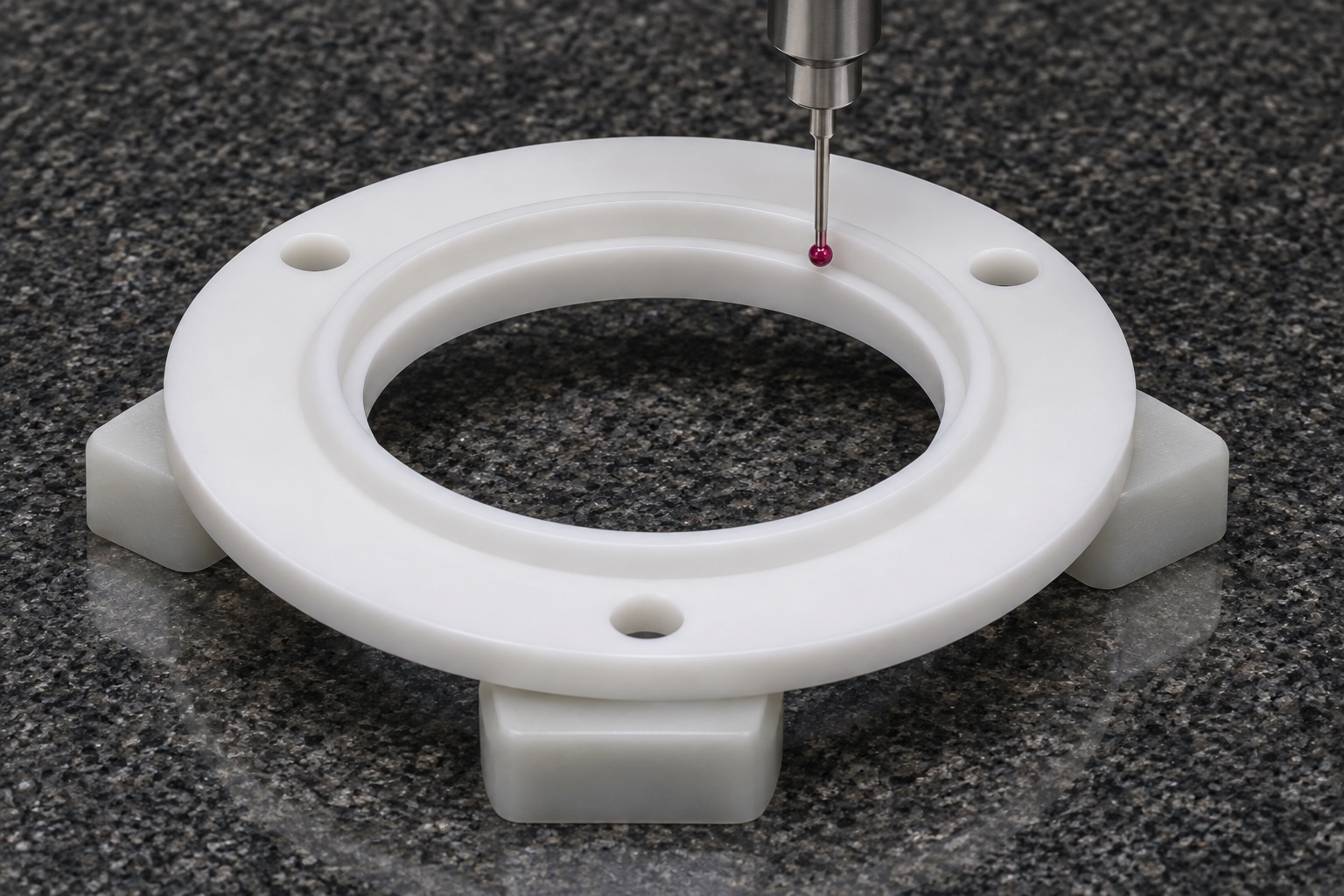
A first-article plan would identify drawing revision, material and final state, inspection support and methods for evaluating opening, step, lip position, seating face and mounting pattern. Each method must answer its actual characteristic rather than being treated as a universal check. A ball reference that passes cannot verify the entire hole pattern or flange geometry. This example publishes no measured values, tolerance capability or acceptance percentages. Real reports need evidence from identifiable parts and should state any unverified features. That clarity lets the device organization combine component information with separate trackball evaluation without mistaking a manufacturing observation for complete system qualification.
Investigate an inert-reference mismatch carefully
If requested, an identified non-electrical reference could be compared with the ring under documented orientation and support. No powered console or clinical instrument is needed. As a hypothetical review situation, unexpected contact would prompt checks of profile, entry, lip height, reference geometry and whether the ring is constrained differently. This is not a reported customer incident. The original observation is retained before correction. A manufacturing deviation and a design conflict require different approved decisions. An apparent improvement after hand smoothing is not sufficient evidence. The comparison cannot establish operating feel, sensor accuracy, durability or clinical suitability of the complete trackball mechanism.
Protect contacts and close the delivery scope
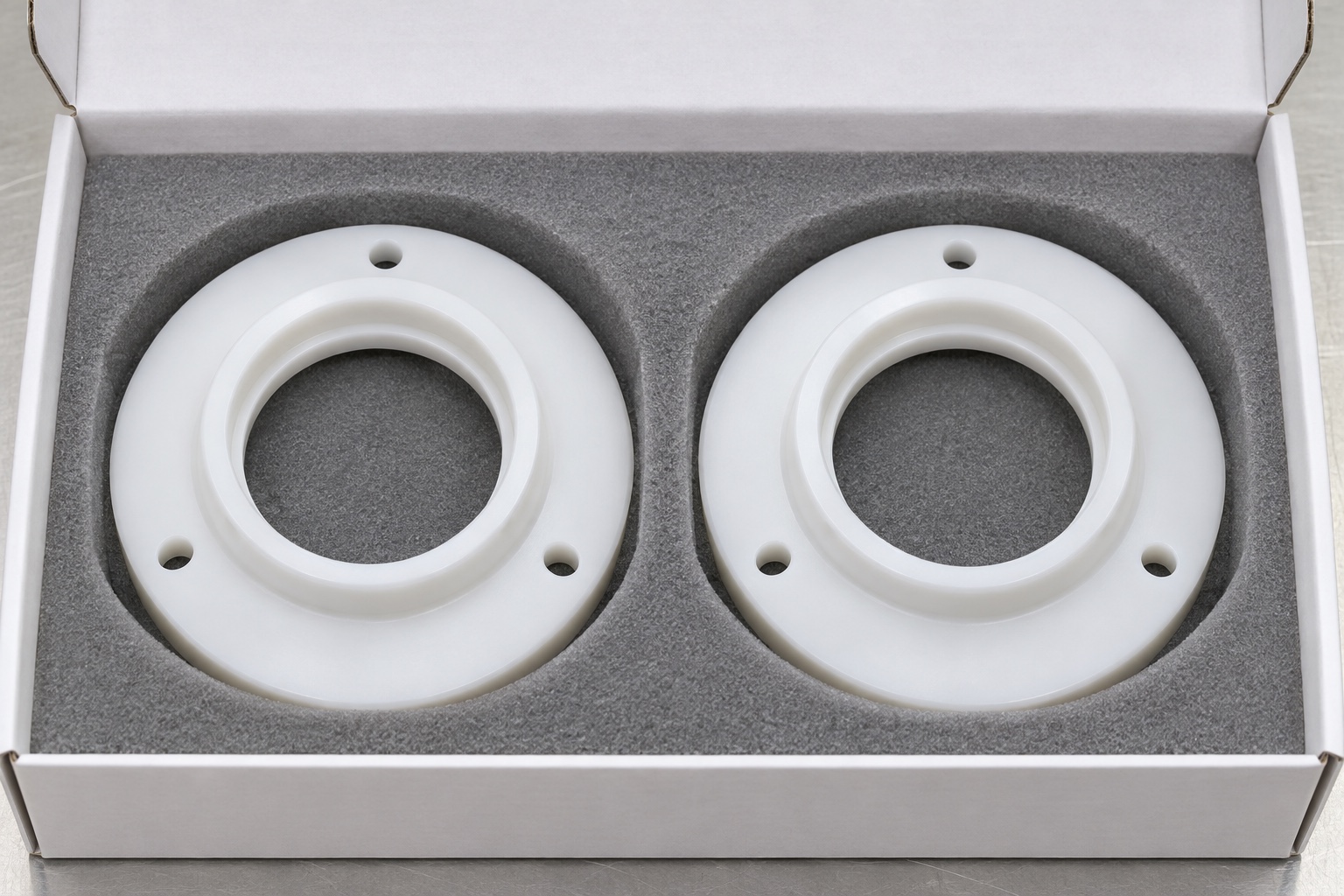
Packaging would keep rings apart and support the flange without loading the working lip. Protective materials should not shed fragments into the stepped opening or fastener recesses. Identification stays outside functional contacts and remains linked to revision and material records. Normal protective wrapping is not called a sterile barrier. To make this an actual order, files, quantity, grade, final condition, inspection scope and delivery protection must be approved. This case provides a concrete machining discussion without inventing a customer, shipment or qualified console. The complete assembly and medical system require separate responsibility and evidence beyond a fit observation on a machined acetal ring.
FAQ
Is this a delivered ring for a named ultrasound console?
No. It is a representative machining and inspection plan, not a compatibility or spare-part approval claim. Actual projects need their own controlled requirements and traceable evidence.
Why specify the lip separately from overall thickness?
Its useful width, profile and axial position determine a different interface from the outer flange. A correct total thickness does not automatically verify the internal step or intended contact band.
Can another white acetal grade replace POM-C automatically?
No. Exact material identity and required documentation must be agreed. Color and family name do not establish equivalence, cleaning compatibility or suitability for the intended device.
Does a mounting-hole screw trial verify the pattern?
No. Hole position relative to the opening and seating references needs an appropriate method. A passing screw does not establish the complete relationship or a permitted tightening condition.
What does an inert reference comparison prove?
Only the observed geometric contact under recorded conditions. It cannot prove input accuracy, operating feel, wear life or medical-system performance, which require separate assembly evaluation.
What must be agreed before production?
Approve matching files, material grade, quantity, final state, functional references, lip and mounting geometry, inspection condition and evidence, plus packaging and any special cleaning requirements.

tanghangyun@oemach.com