
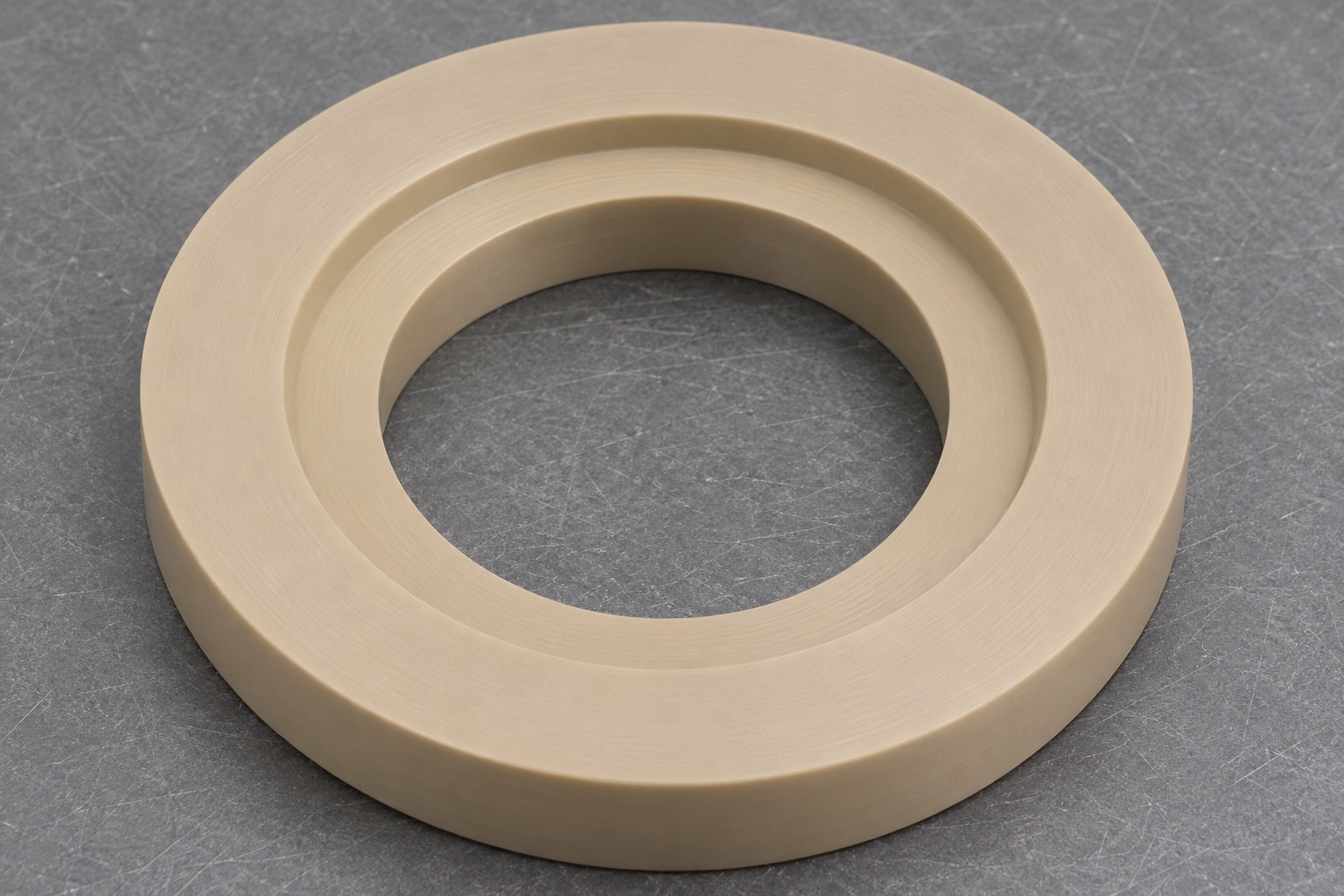
Representative example and application boundary
This PEEK diaphragm backing ring for medical suction pump engineering is a representative CNC turning example, not a customer delivery or a qualified replacement part. It considers an annular polymer component with a central opening and stepped support regions. The case follows proposed manufacturing and inspection decisions that an actual drawing would need to resolve. No customer, certification, measured dimensional result or pump performance is claimed. The ring is not installed in a clinical suction unit. Its geometric review remains separate from diaphragm compatibility, leak resistance, service life and approval of a complete device intended for a defined medical use.

Geometry selected for review
The generic ring has an exterior locating region, a central bore and annular faces at defined levels. The drawing must identify which face locates the part, which region supports a separate component and which areas provide clearance. A broad apparent surface is not automatically a required contact over its full area. The images do not establish a pump interface or production dimensions. The manufacturing question is how to preserve the relationships between the opening, step and useful support regions while avoiding a fixture-induced shape. A real order would replace this general arrangement with the owner's controlled model, references and acceptance criteria.
Inputs required for a real quotation
The package would identify the PEEK grade, stock form, quantity, reference scheme, face geometry, bore requirements and final condition. It would also specify inspection deliverables and any permitted conditioning or downstream process. Filled and unfilled grades must not be silently interchanged. Application requirements for exposure, cleaning or contact with another component belong in the approved design inputs. The machining supplier should not infer them from the term medical suction. Any inaccessible feature or uncertain measurement condition should be resolved before order acceptance. This representative case is a discussion framework and does not supply a qualified material or a validated device interface.
Stock preparation and traceability
The proposed route starts with identified unfilled PEEK stock matching the actual order requirements. Allowance and stock form should provide stable support during roughing and finishing without creating an unnecessarily vulnerable ring too early. Material and revision identity remain associated with the component through the process. A proposed change in stock or conditioning history requires review. The process sheet identifies when any approved conditioning would occur and which measurements follow it. No such process is claimed to have been carried out here. The example describes the information needed to relate actual material, operations and inspection observations on a real manufactured batch.
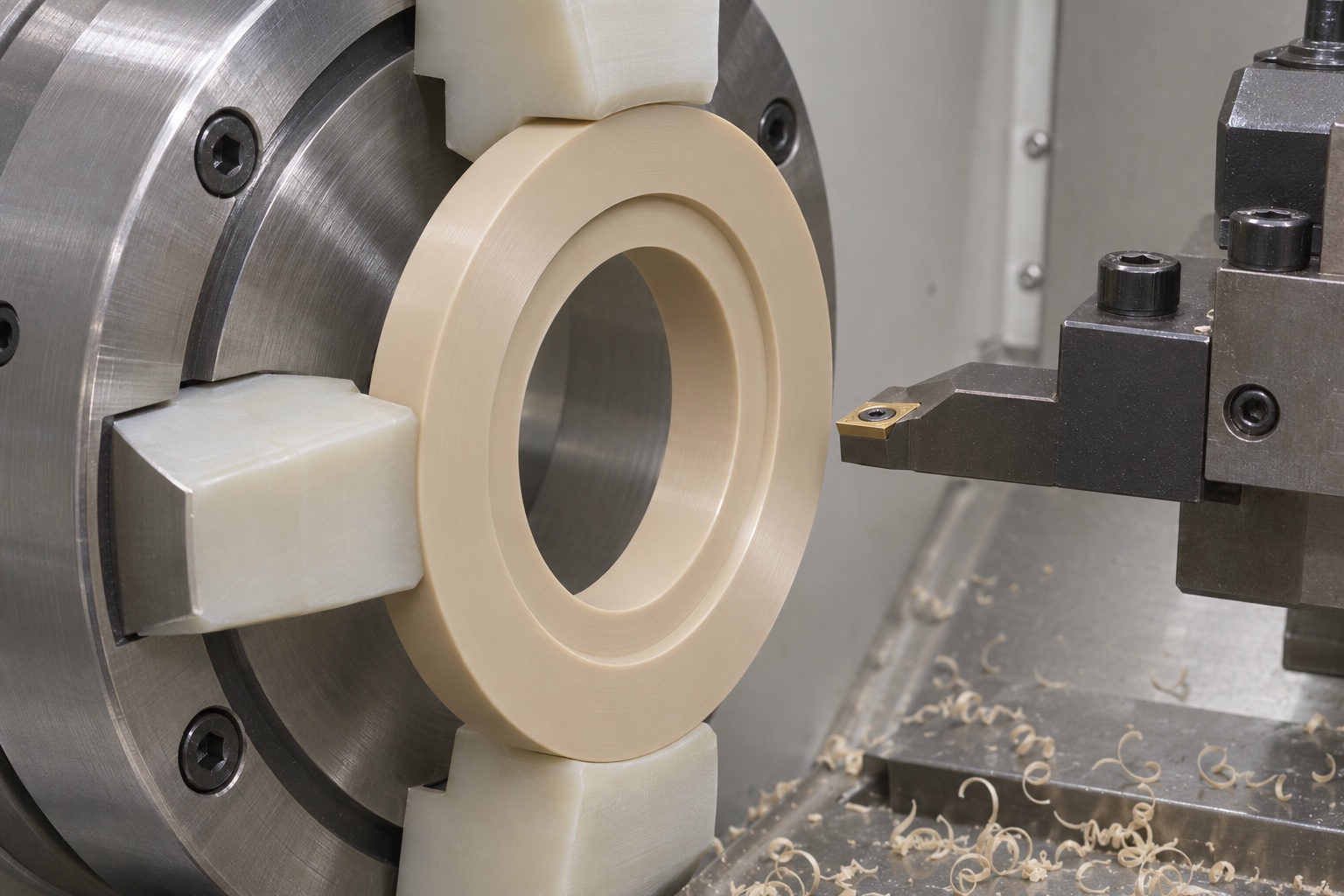
Rough turning with support retained
A first stage would prepare the reference region and remove material while preserving enough support for the stepped faces and opening. Tool access and the remaining annular section need review together. The plan should identify the condition in which the last cut is made and how the ring is separated or transferred afterward. Cutting heat and stock history are considered when selecting the finish sequence. No universal speed, feed or heat-treatment schedule is prescribed. The route must avoid accepting a measurement taken under manufacturing restraint as though it represented the part in the required free or defined mounted condition.
Workholding for the finishing stage
The finishing fixture would locate the ring at approved reference regions while limiting loads on thin lips or narrow lands. A suitable collet, soft-jaw arrangement or dedicated support depends on the actual drawing. The process sheet shows contact locations and orientation rather than relying on an operator's preferred grip. A nearly complete ring may behave differently from the rough blank under the same force. The proposed inspection therefore distinguishes the clamped manufacturing state from the state required for acceptance. The choice of fixture is part of the review, not by itself evidence that the finished component is free of distortion.
Completing the step, faces and bore
The route would finish related face and bore features while preserving a reproducible reference. If reversal is needed, define how the completed seat is protected and the datum recovered. The useful bore length is distinguished from chamfers and relief. The annular step has its own axial and face requirements rather than being accepted only because the bore diameter is correct. Any edge treatment must preserve the useful support width. No achieved parallelism, flatness or dimensional capability is asserted. Those characteristics would have to be specified by the real drawing and supported by actual observations collected after the agreed final operations.
Proposed first-article inspection
The inspection list would identify the supporting face, annular step, bore and required exterior relationship. It would document support, measurement condition and the regions actually evaluated. Suitable optical or low-force contact techniques may be considered according to access and the required uncertainty. One thickness reading cannot represent every face requirement. This representative case supplies no measured results. A real report would associate each observation with part identity, material, drawing revision and the final process condition. It would distinguish geometric measurements from any separate seating observation and would identify limitations instead of treating unrecorded regions as automatically accepted.
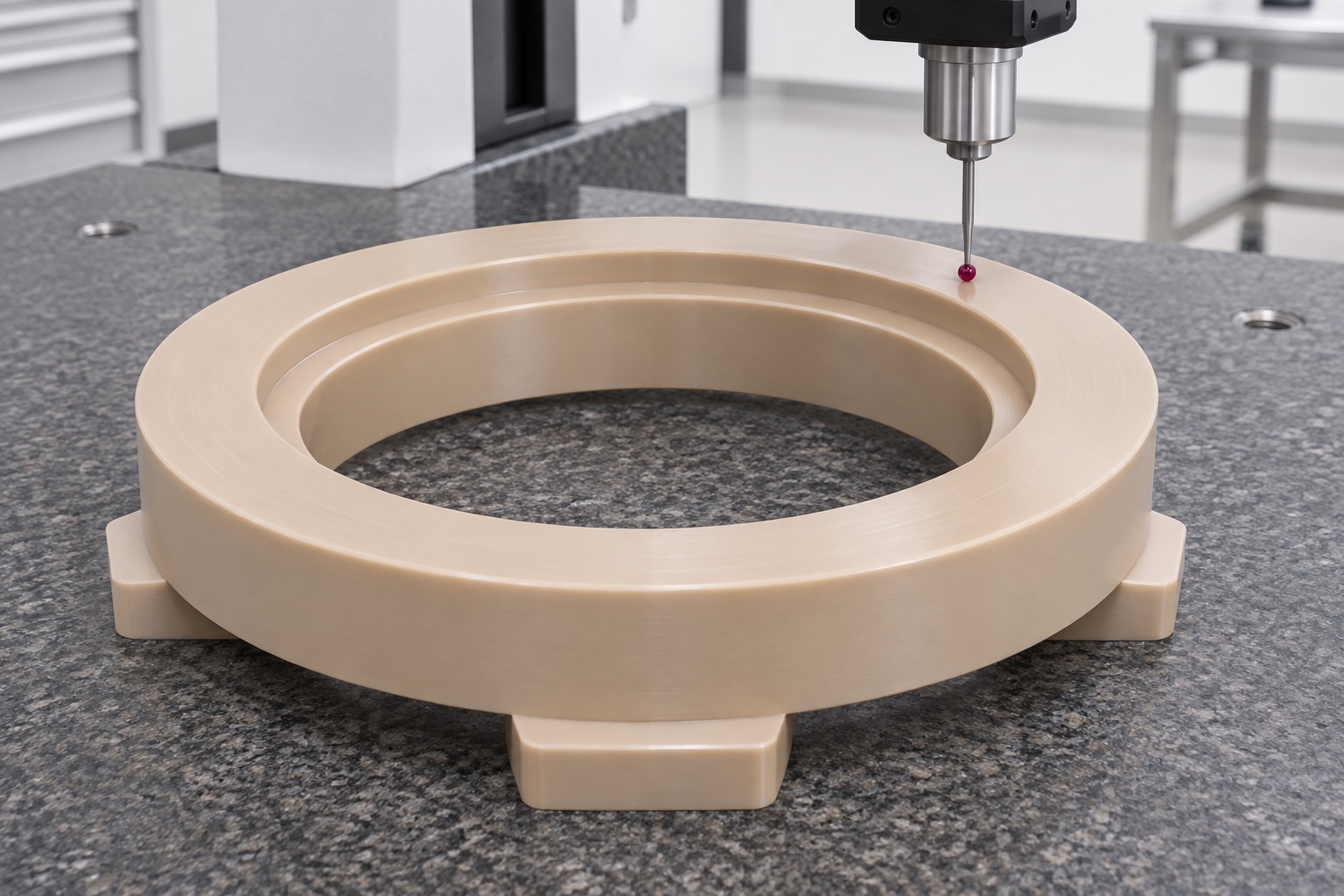
Inert seating comparison
After dimensional checks, a separate bench fixture could use an identified inert reference to examine seating and clearance. The procedure would record support, orientation and the contact observations being made. It uses no operating suction pump, vacuum source or production diaphragm. A reference that rests stably can help identify an unintended high point in that particular arrangement, but it does not prove leakage performance, diaphragm life or application suitability. Keeping this observation separate from the dimensional record makes the evidence more useful: the result can be interpreted within its actual conditions without being promoted into qualification of an entire medical suction system.
A possible rocking observation
Suppose the reference rocks when placed on the intended annular support. The next review would compare local edges, ring support, reference identity and measured face geometry. The team would preserve the observation before changing the component. Lowering all faces or enlarging the bore automatically is not an appropriate default response. This is a decision example, not a production defect report or a claim of successful correction. Approved rework would require repeat inspection of affected dimensions and the same controlled comparison. Any change in reference or fixture also needs recording so a second observation is not falsely attributed solely to the modified ring.
Packaging and record separation
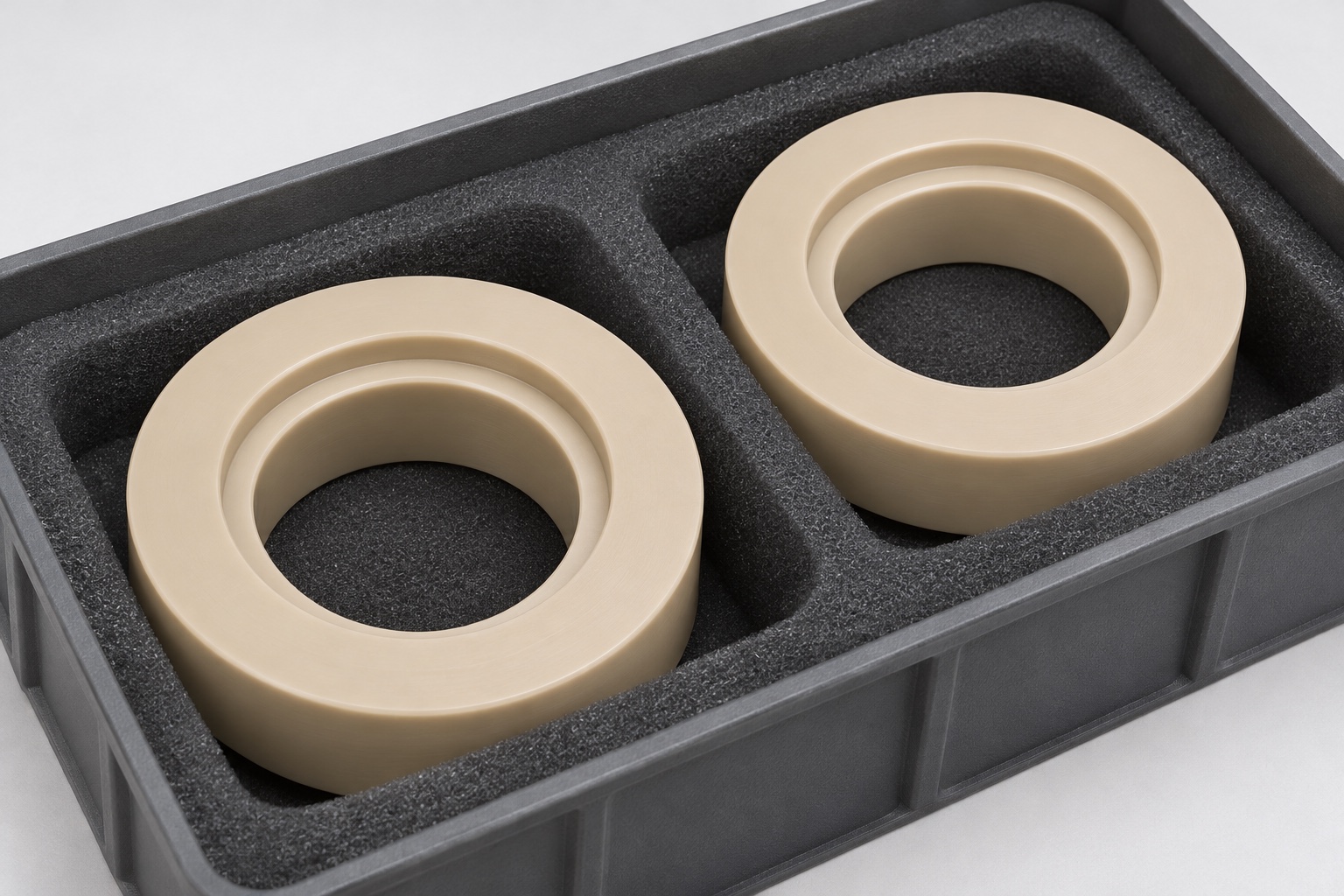
The packaging proposal keeps rings apart and supports robust areas without bending thin annular regions or pushing unapproved inserts through the opening. Contact materials and closures must follow the actual handling requirements. Identity remains linked to the material and inspection documents, particularly when similar sizes or revisions are present. Ordinary protective packaging does not establish sterile processing, leak resistance or a defined cleanliness classification. Those requirements need separate instructions and acceptance evidence where applicable. The receiving team should be able to identify the correct component record and repeat the dimensional inspection without first finding that packing loads have altered the geometry.
Requirements for an actual order
Provide the final model and drawing, PEEK grade, quantity, reference structure, step and bore requirements, final surface condition and inspection deliverables. State any approved conditioning step and whether a mounted-state check belongs in the scope. Resolve measurement access and support concerns before committing to a critical characteristic. Agree how first-article findings and proposed changes will be reviewed before a batch continues. The value of the representative case is its proposed route and evidence structure. It does not replace a released interface, actual measurement results or the separate evaluation needed for diaphragm compatibility, pump function and approval of a complete clinical device.
FAQ
Is this an actual suction pump customer delivery?
No. It is a representative machining example without verified delivery data, measured production results or performance claims for a medical device.
Does the picture define an approved diaphragm interface?
No. The actual drawing and component specifications must define contact regions, dimensions and acceptance requirements. The image is not a replacement-part drawing.
Can reinforced PEEK replace the unfilled grade?
Only after approval against the actual material and application requirements. Similar appearance or the shared polymer family does not establish equivalence.
Which state should a first article be measured in?
Use the condition required by the approved inspection plan, explicitly distinguishing free-state geometry from any defined mounted condition.
Does a stable reference prove a seal?
No. The unloaded comparison observes geometry in one fixture. Leakage, suction behavior and diaphragm performance require separate evidence.
What should happen before reworking a high annular face?
Preserve the observation, inspect edges, references and support, review measurements and approve a correction before repeating affected checks.

tanghangyun@oemach.com