
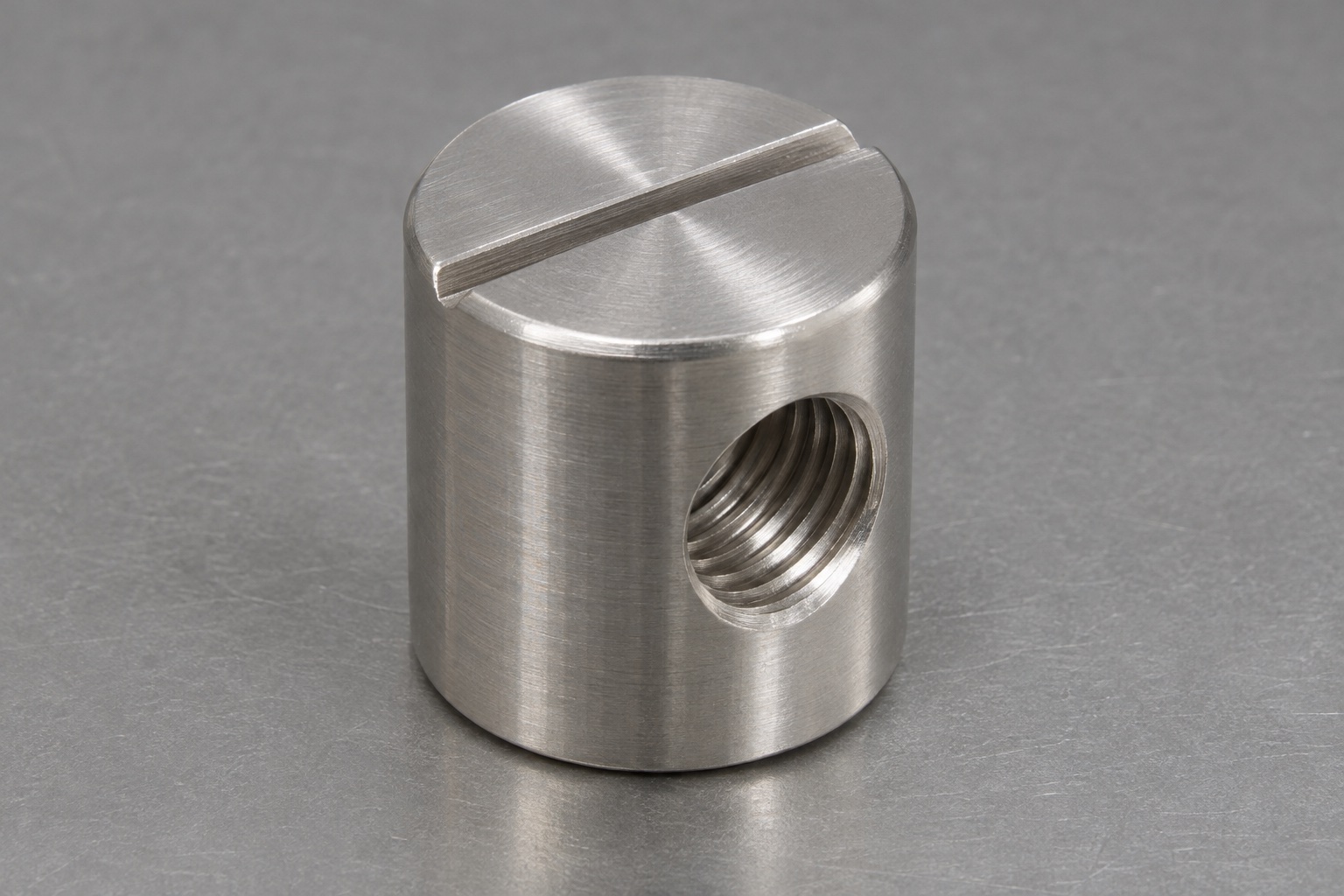
Scope of the representative fastener
This representative example proposes a short 316L cylindrical nut for a mechanical service-panel joint inside medical equipment. It has one transverse female thread through the curved side and a straight alignment slot across a solid circular end. No axial threaded bore, bolt, housing or retaining accessory is supplied in the illustration. It is not a documented customer delivery or a report of a measured sample. The proposed manufacturing route claims no achieved tolerances, preload, load capacity, fatigue life, resistance to loosening, medical certification or sterile delivery.

Review the bolt and receiving arrangement
The proposed review would collect the controlled drawing, model, receiving-hole geometry, bolt specification and service-access envelope. The equipment designer would define how the barrel is inserted, oriented, retained and removed. The outside diameter would not be assumed to require an interference fit. Bolt approach and useful engagement would be reviewed with the actual housing. Missing information would remain an open engineering item rather than an operator's choice. A background catalog illustration would not establish the custom nut's dimensions or transfer a standard fastener's capacity to this medical equipment concept.
Preserve the 316L material and revision identity
A real purchase order would specify the required 316L standard, stock form and traceability documents. The proposed traveler would retain material identity through turning, transverse machining, finishing and inspection. A similar stainless blank would not be substituted based on appearance. Any external treatment would be linked to the actual drawing revision and ordered condition. This example does not invent a material certificate, customer approval or supplier qualification. Cleaning exposure and medical application suitability would remain separate assessment questions rather than assumed outcomes of selecting a stainless alloy for a mechanical component.
Establish the turned body and end references
The proposed turning sequence would create the cylindrical outside surface and circular ends according to the approved definition. The programmer would retain sufficient material for the transverse thread and end slot. Workholding and stock allowance would be selected for the actual dimensions and machine. Temporary grip or center features would not remain in a functional area unless the drawing allowed them. The inspection plan would define the delivered support and reference condition. No numerical diameter, length tolerance or achieved result is asserted here because no real component has been manufactured or measured for this example.
Locate the transverse opening
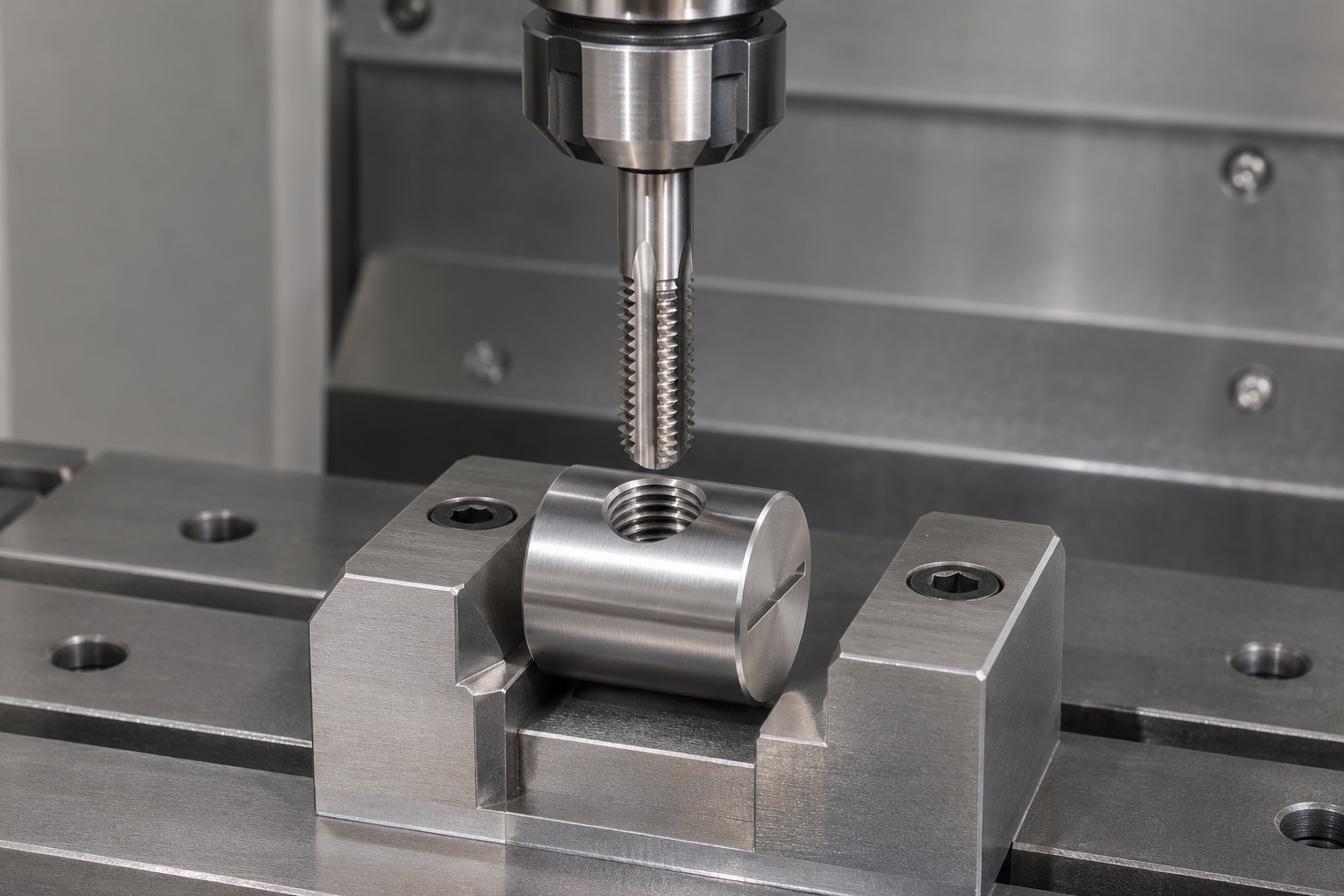
The side-hole operation would establish its released position along the barrel and relationship to the cylinder axis. A fixture would provide stable support and tool access to the curved surface without damaging the finished outside contact. The review would confirm the relevant end reference and any required orientation convention. A centered-looking hole in a photograph would not replace those dimensions. If the model and drawing disagreed, the issue would return for approval before machining. The supplier would not change the hole to an axial bore because it was more convenient to produce.
Produce and check the specified female thread
The proposed threading operation would follow the approved system, size, pitch, hand, fit and useful engagement definition. Curved entries and permitted chamfers would be included in the review. No universal cutting parameters or assembly torque would be supplied. The chosen inspection would address the thread within its defined scope without implying that a passing gauge proves complete-joint strength. If a bolt could not reach the useful threaded region in the actual housing, that would be a design or assembly issue to resolve, not a reason to alter the thread silently.
Machine the slot to its approved convention
The end-face slot would be made to the specified width, depth and orientation relationship. If it served as an indicator of thread direction, that relationship would be included in inspection. Tool access would be checked at the intended assembly stage. The supplier would not assume that another catalog cross dowel used the same convention. An axial opening, cross recess or different drive would require an authorized change. The slot would not be deepened simply to accept a convenient screwdriver, particularly where that change could affect the remaining section above the transverse hole.
Finish entries and preserve the ordered condition
The proposed finishing instruction would address both side-hole entries, slot edges and circular-end transitions. Attached burrs would be removed without erasing useful thread or changing approved contact regions. A nonconforming thread would not be hidden by uncontrolled chasing or polishing. Any authorized rework would be documented and inspected again. Passivation or another ordered treatment would follow the agreed scope and final acceptance condition. A bright surface would not establish measured cleanliness, validated disinfection or sterile supply. Material, revision and inspection identity would remain associated with the component through any external operation.
Inspect the body, thread and orientation together
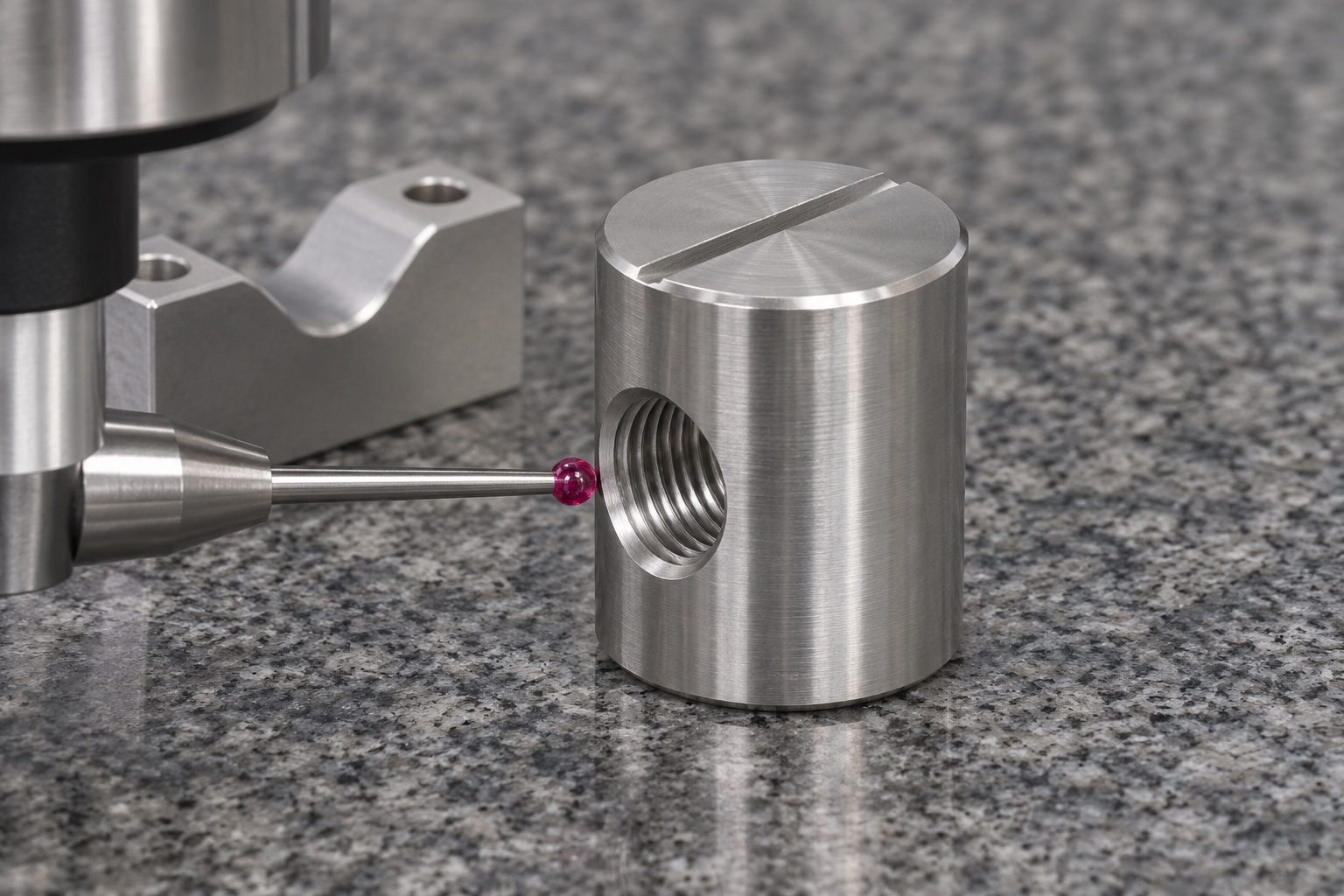
The proposed inspection record would identify the actual requirements for barrel diameter and length, transverse hole location, thread characteristics and slot relationship. Methods would be selected for access and required uncertainty. A thread gauge alone would not document the position of the thread within the barrel, and a measured outside diameter would not verify the internal interface. This representative example contains no actual measurements. A real acceptance report would need identified instruments, sampled characteristics, results and decisions against the controlled drawing revision rather than a generic statement that a bolt fitted.
Limit an optional joint-assembly observation
An agreed development observation could examine insertion, orientation, bolt access and seating with identified mating parts. It would record the procedure without inventing a tightening torque, preload or capacity. Favorable hand assembly would not establish fatigue resistance, resistance to loosening or safe retention during equipment operation. Those questions require the real complete joint and relevant assessment. Unexpected interference would lead to a review of the housing, bolt and barrel references before any part was modified. Development samples would remain distinguishable from released production until approved changes entered controlled manufacturing and inspection documents.
Protect the slot and threaded entries during dispatch
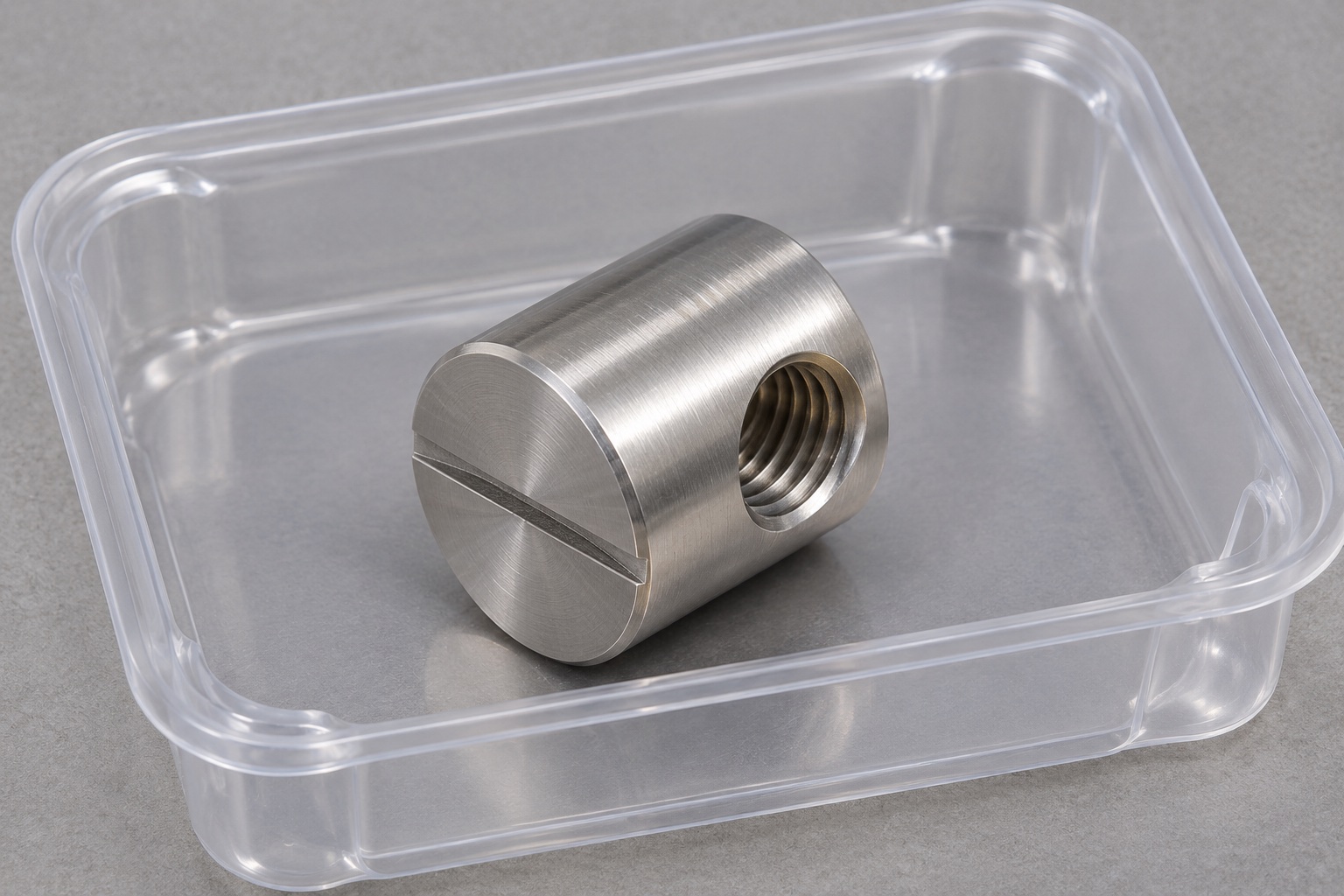
The proposed package would individually separate barrels so that neighboring components could not strike the slot or thread entries. Protective materials would be chosen for the ordered finish and any stated restrictions. Labels or associated records would preserve part number, revision, material identity and inspection status. The package would be ordinary mechanical protection, not a sterile delivery system. If the purchaser performed final cleaning or assembly, the handover condition would be defined. The generated illustration is not evidence of a manufactured lot, a customer shipment or a verified medical fastener supply arrangement.
Retain the joint-specific repeat-order basis
A repeat order would preserve the approved barrel geometry, receiving fit, bolt approach, full thread definition, slot convention, material condition and inspection scope. A changed housing or bolt would trigger review even if the nut silhouette remained unchanged. The example supports a specific supplier discussion about a custom transverse-thread component, not a universally interchangeable or rated cross dowel. No customer history, production quantity or measured improvement is fabricated. The equipment team would separately assess the complete joint and any safety requirements before releasing it for its intended medical equipment application.
Manufacturer background reference: www.fastenright.com.
FAQ
Is this a verified customer-delivery case?
No. It is a representative proposed machining workflow with illustrative images. There is no actual order, measured sample, delivered quantity or performance result. A real project would require its own approved design, production records and acceptance evidence.
Does the barrel have an axial threaded bore?
No. Its female thread is transverse through the curved side. The circular end has a straight alignment slot and otherwise remains solid in this concept. Changing that arrangement would require an authorized design revision and matching inspection requirements.
Is the slot orientation automatically standardized?
No convention is assumed. The actual drawing would specify the relationship needed by the assembly, and inspection would verify it where required. The supplier should not copy another product's slot direction or infer orientation from an unscaled perspective illustration.
Are a bolt, housing and locking method included?
No. Those are separate components or design inputs. Their definitions are needed to assess the complete joint. The nut alone does not establish useful engagement, preload, resistance to loosening or a safe service-panel retention arrangement.
Does 316L material establish a load rating?
No. Material identity is only one part of the real geometry and joint assessment. Bolt engagement, housing support, load path and operating conditions also matter. This example provides no measured or certified capacity and does not inherit a catalog fastener's rating.
What would be preserved for repeat manufacture?
Retain controlled model and drawing revisions, bolt and housing definitions, thread data, slot convention, material and finishing scope, actual inspection requirements and protective packaging. Approved changes should enter those documents instead of relying on a manually fitted development sample.

tanghangyun@oemach.com