

Representative manufacturing scope
This case proposes a single-piece PPSU cruciform divider for an inert surgical accessory tray arrangement. It is a representative machining example, not a documented customer delivery or a qualified tray product. It claims no achieved tolerance, certification, cleaning result, sterilization cycle life or clinical suitability. The purpose is to explain how geometry, material and inspection could be specified before a real order. The responsible tray project would define the actual accessories, contacts and qualification needs. A manufacturing route and its accompanying images do not establish application performance or replace the evidence required for a completed medical system.

Proposed cross-shaped part envelope
The proposed component is a thick flat plus-shaped part with four equal-length orthogonal rectangular arms meeting at a central region. Each arm has the same width and the same constant axial thickness. The top and bottom are continuous flat surfaces, and small concave fillets connect neighboring arm sides near the center. There are no holes, slots, feet, stacked bars or separate joints. This distinguishes the example from a divider assembled from crossing strips. The released drawing would define dimensions and allowable transitions, while the photographs would serve only to make the selected part and manufacturing setting understandable.
Define the accessory and tray interfaces
The drawing owner would identify where the divider seats, which arm sides contact accessory references and which regions need clearance. The part's location and retention cannot be inferred simply because it resembles a tray separator. Those interfaces would guide the datum system and acceptance requirements. An inert placement observation, if requested, would use controlled envelopes and record revisions. It would not establish retention strength, instrument protection or drainage performance. The proposed case separates that limited assembly information from the dimensional acceptance of the machined divider and from any validation needed for the actual tray and accessories.
Resolve profile dimensions and corner requirements
A quotation review would distinguish overall spans, individual arm lengths, widths and the defined central region. It would clarify any equal-arm, symmetry or perpendicularity requirements instead of relying on a visually balanced cross. Internal corner radii would be reviewed together with local clearance and cutter access. Redundant tolerances or conflicts between model and drawing would be returned for clarification. A smaller concave radius might change the proposed process, while an oversized radius might reduce usable space. Neither a relief cut nor a revised corner would be introduced silently as a convenient substitute for the approved profile.
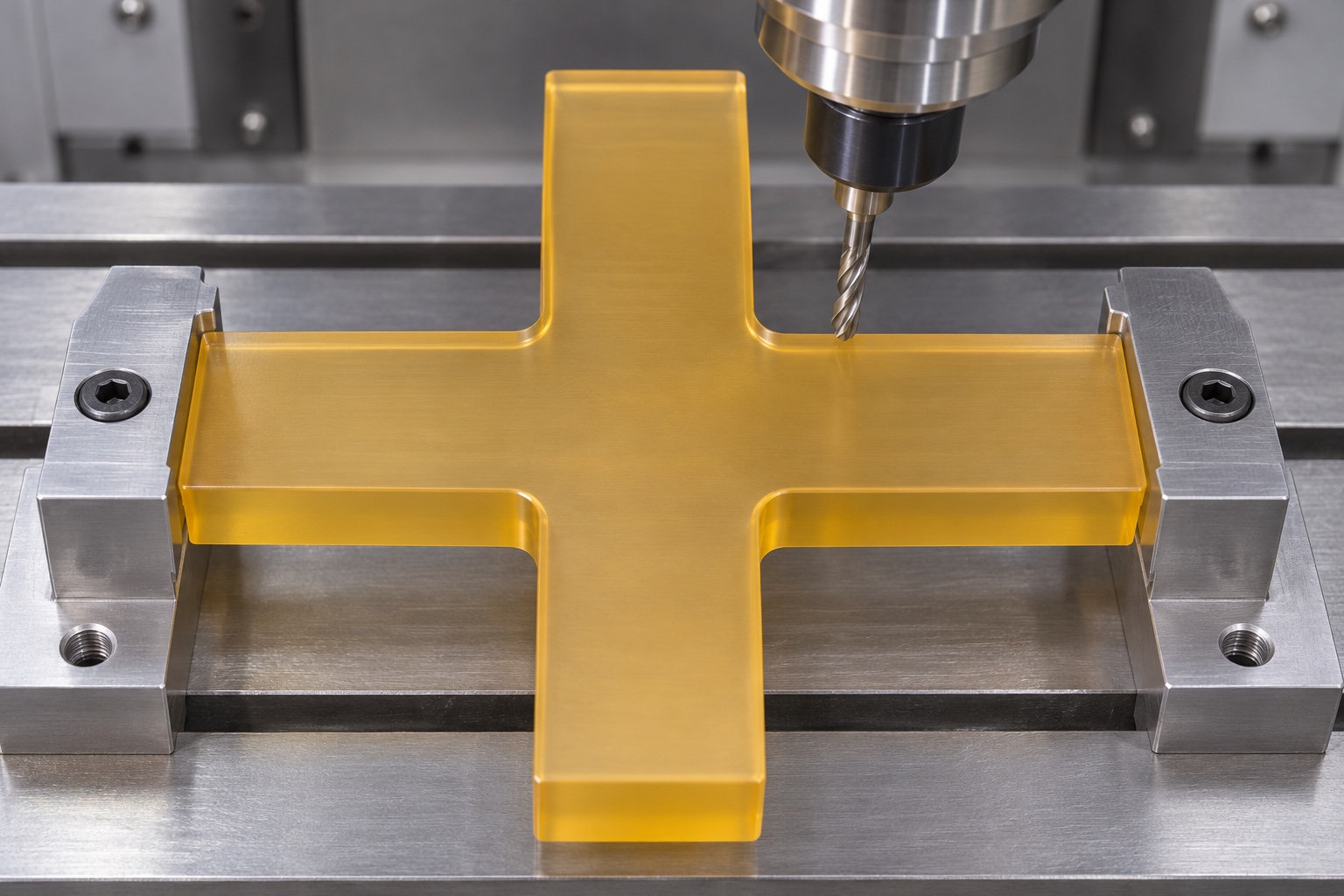
Identify the actual unfilled PPSU material
An actual purchase would specify the required PPSU grade, stock form and supporting source documentation. The proposed natural amber appearance would not serve as material identification, and PSU would not be substituted because its name is similar. Records would remain linked through blank preparation, milling and approved subsequent operations. This example does not present a material certificate or claim another supplier's medical certification. Any cleaning exposure, biological assessment or repeated-sterilization requirement would need its own project-specific basis. The material record would identify what was supplied, not establish every performance claim for the finished accessory tray.
Propose a supported milling sequence
A candidate route would prepare useful flat references, retain adequate support and machine the four-arm profile with access to the internal corners. The order for removing surrounding stock and completing final surfaces would be selected for actual proportions, material condition and tolerances. Holding contacts would not be allowed to damage an accepted contact region. The process could change after development review, but changes and their purpose would be recorded. No universal tool parameters, waiting period or production time are asserted here. This is a proposed sequence for discussion rather than evidence that a particular process has already produced accepted dividers.
Plan measurement after release from machining restraints
The representative plan would state the support and conditioning used for final inspection. A divider forced flat against a fixture would not automatically represent the shape of the supplied part after release. If an intermediate check or stabilization step were needed, its reason and conditions would be documented. The case reports no measured distortion and does not promise that one operation order eliminates all dimensional change. Instead, it identifies the need to align the manufacturing route and acceptance method with the intended state. Actual development findings would have to be verified on real parts before they became process evidence.
Preserve the profile during finishing
Deburring would address tips, side boundaries and concave transitions without changing required arm lengths, widths or corner radii. A broad manual blend could modify the clearance region, even if the overall cross remained recognizable. Any proposed chamfer or relief beyond the drawing would require approval. Surface appearance would be separated from specified roughness and cleanliness requirements. Tools and handling would match the intended outgoing condition, and visual checks would not be presented as proof of chemical compatibility or cleanability. The finishing plan would identify which features require confirmation after operations capable of affecting the final profile.
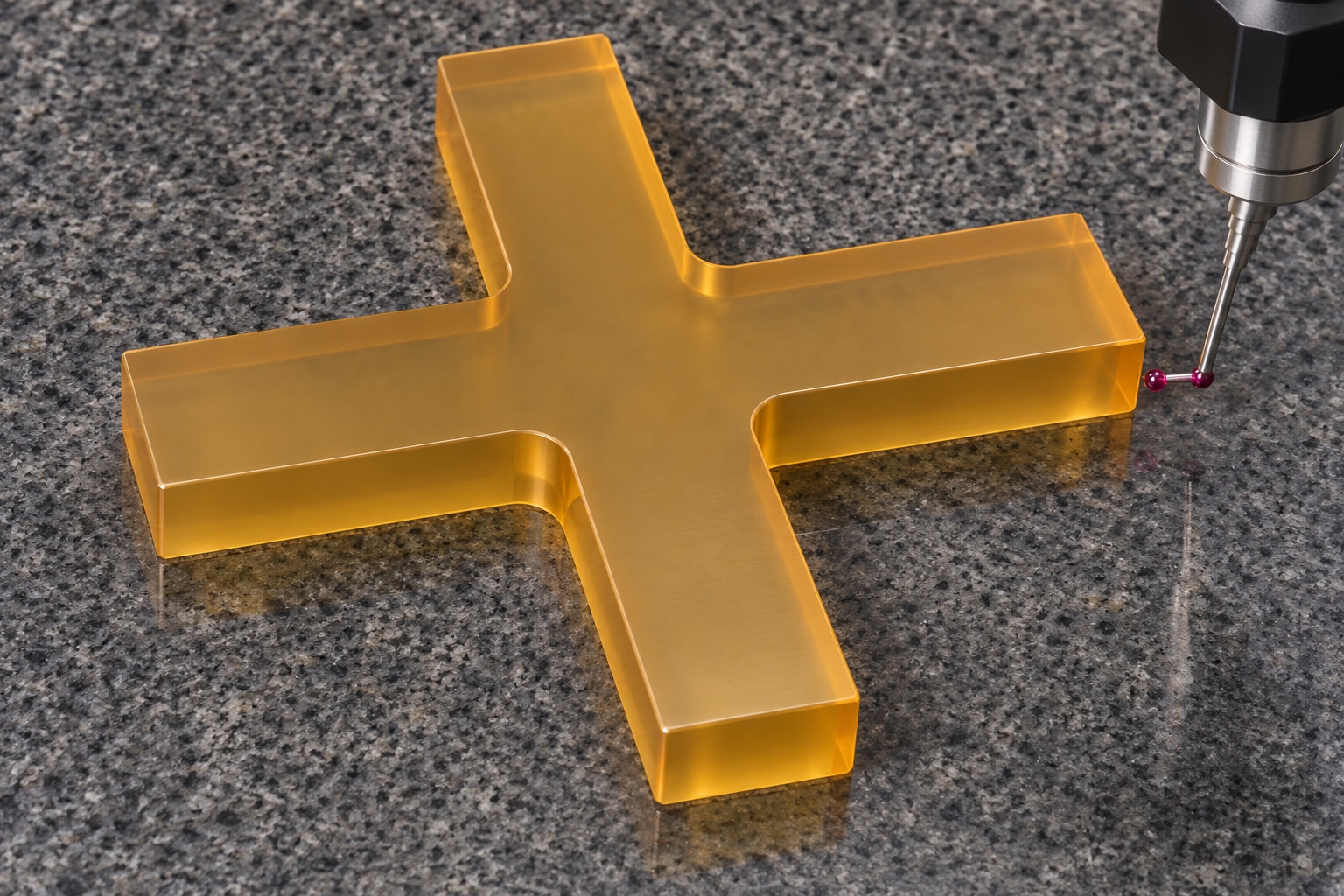
Build the proposed first-article evidence
The first-article record would identify drawing revision, material, final processing condition, references and appropriate results for each controlled feature. Overall spans, individual arms, widths, internal radii, angular relationships and face requirements would be evaluated where specified. A coordinate or optical approach would need capability and access suitable for the translucent polymer and actual tolerances. Derived dimensions would identify their underlying observations. Nominal model values would not be copied into measured fields. Because this case has no verified delivery data, it reports no achieved numerical result; an actual release would require evidence generated for the completed parts.
Limit any inert arrangement check
An agreed placement check could show an obvious interference with a tray wall or accessory envelope. It would identify reference revisions, support and the observation scope. It would not establish sterilization performance, cleaning efficacy, transport retention, instrument protection or clinical usability. A favorable visual arrangement would not override a failed component dimension. If an issue appeared, both the divider and its mating references would need review rather than assigning the problem to one feature without evidence. This case does not claim that such a trial was performed; it explains how it could be defined as supplementary information.
Specify protective handling and identification
The proposed packaging would separate dividers and protect arm tips, flat faces and internal corners from loose hardware and contact damage. Part and revision identity would accompany the package without uncontrolled labels on functional surfaces. A requested residue limit or cleaning condition would require an agreed process and verification. A protective support and ordinary pouch would not constitute sterile packaging, validated cleaning or a qualified shipping system. No shipment outcome is asserted. The supply description would stay within the supplier's documented machining and protective-handling scope, leaving additional qualification explicit rather than implied by the word medical.
Approve the real manufacturing scope before a lot
Before a genuine small-batch order, the parties would approve profile geometry, internal radii, references, material grade, surface state and final inspection condition. DFM review would resolve corner access, support during profile completion and permitted edge treatment. Actual first-article results, deviations and authorized changes would support subsequent purchasing decisions. The proposal would then provide a clear basis for comparing custom PPSU machining services without fictional customer achievements. The divider's component requirements can be well defined while cleaning, sterilization and application suitability remain separately controlled responsibilities of the tray project.

FAQ
Does this describe a delivered sterile tray component?
No. It is a representative manufacturing proposal. It claims no customer delivery, sterile product, certification, achieved tolerance or validated cleaning result. Actual supply and qualification would require their own controlled evidence.
Are two bars assembled to form the cross?
No. The proposed part is machined as one continuous piece with four arms and flat top and bottom surfaces. A construction made from joined bars would be a different design with additional interface requirements.
Why review arm lengths as well as overall size?
Overall spans alone may not establish each arm, the central region or symmetry. The drawing should define measurement conventions and local profile requirements so that acceptance does not rely on a balanced appearance.
Can the supplier add corner reliefs automatically?
No. Extra reliefs can change clearance or contact boundaries. Review tool access and the specified internal radius during quotation, and obtain approval for any proposed geometry change before manufacture.
Would a flat clamped part prove its released flatness?
No. The acceptance condition must be defined. A fixture can restrain a polymer into a shape different from the supplied state. Agree support, conditioning and measurement after release where required.
What is needed before a repeat order?
Use approved geometry and grade, actual final inspection results, authorized changes and agreed cleaning and packaging requirements. This representative route and its images are not completed production or application qualification.

tanghangyun@oemach.com