
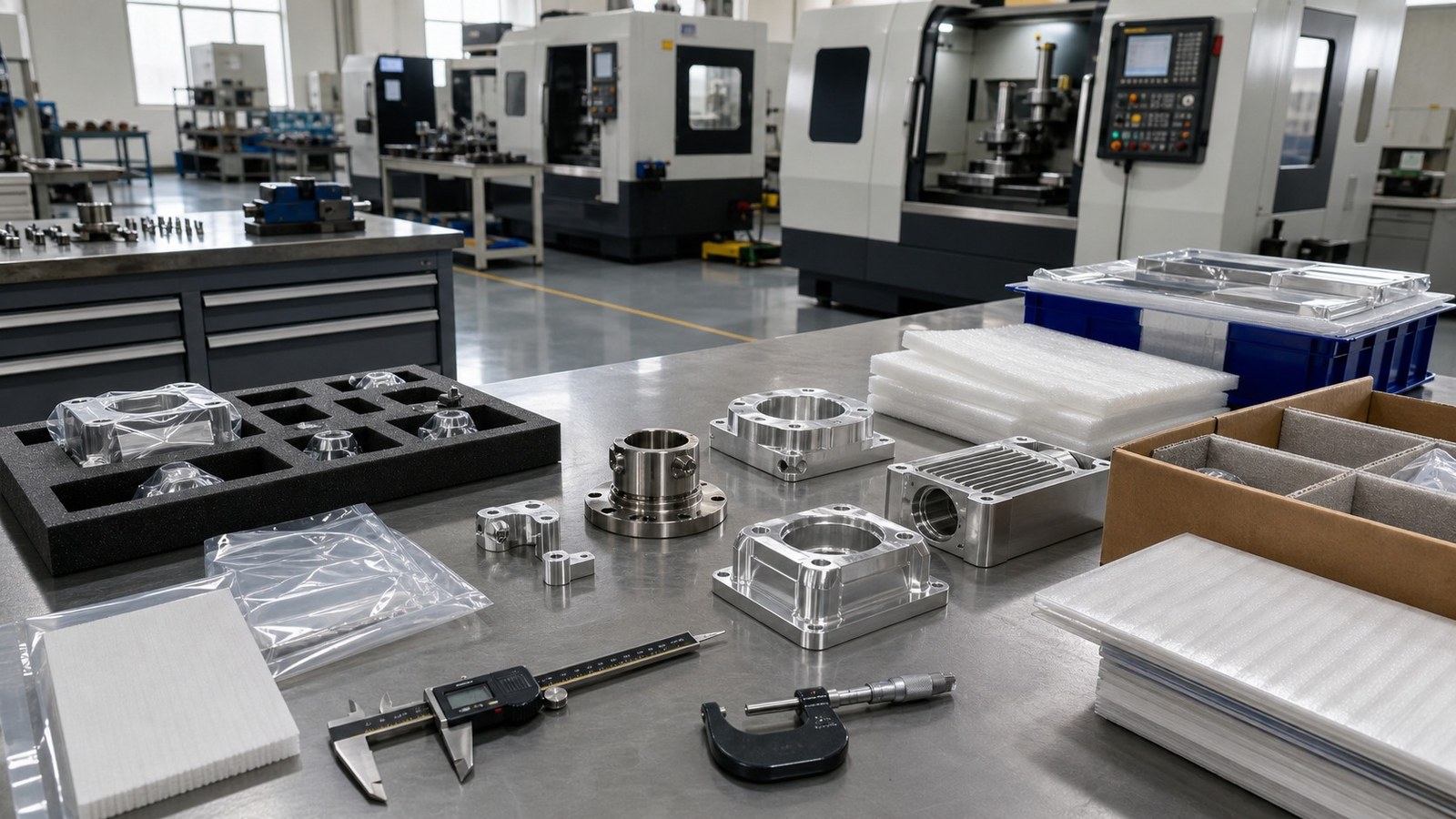
Summary: Packaging is part of the manufacturing handoff, not merely a shipping activity. OEMACH reviews material behavior, functional surfaces, part geometry, transport conditions, and assembly sequence before selecting isolation, buffering, labeling, and final packing methods.
Why packaging matters after CNC machining
After CNC machining, parts can still be scratched, dented, contaminated, oxidized, or slightly deformed during cleaning, transfer, surface finishing, packing, and transportation. A datum face, precision bore, thread entrance, sealing surface, or visible anodized face may lose usability even when the nominal size has already been machined correctly.
Surface texture is a controlled product requirement when it is defined in technical documents, so packaging must not change a functional or cosmetic surface. [Source: ISO 21920-1:2021] For bore and shaft interfaces, tolerance zones and fits affect assembly behavior, and local bruising around an edge may change contact conditions. [Source: ISO 286-1:2010]
Four details to confirm before packing
Material and surface condition
Aluminum parts require scratch and color protection after anodizing. Stainless steel parts require attention to cleaning residue, moisture, and contact with different metals. Copper parts need reduced fingerprints and oxidation exposure. Engineering plastics require pressure and temperature control.
Functional and cosmetic surfaces
Datum surfaces, sealing surfaces, precision holes, pin holes, threads, and controlled texture areas should be marked during packing review. Geometric controls such as flatness, perpendicularity, and position define assembly relationships, so support material must not create hard pressure points on controlled surfaces. [Source: ISO 1101:2017]
Weight and stiffness
Thin-wall plates, long shafts, cantilevered parts, and heat-sink fins should not be stacked randomly. Heavier parts need stable location inside the box to avoid movement during transport.
Transport and storage conditions
Local delivery, long-distance freight, and temporary storage require different moisture protection, cushioning, and box strength. The buyer should clarify storage environment, unpacking method, and whether parts need to be grouped by assembly sequence.
Common risks and practical controls
| Risk area | Typical cause | Packing control |
|---|---|---|
| Precision machined face | Direct stacking or chips trapped between parts | Clean first, then use soft isolation layers |
| Hole and thread entrance | Collision during transfer | Use suitable caps or clean protective material |
| Anodized surface | Friction and hard packaging edges | Pack separately and limit movement in the box |
| Polished or textured face | Fingerprints or adhesive residue | Use clean, non-contaminating isolation material |
| Thin wall or fins | Compression and side impact | Support non-functional rigid areas |
Suggested workflow for small-batch precision parts
1. Review the controlled drawing, order requirement, material, and surface treatment condition.
2. Remove burrs, clean, and dry the part before sealing it in packaging.
3. Protect precision bores, threads, thin walls, sharp edges, and treated surfaces according to risk.
4. Select individual isolation, layered trays, custom liners, or separate small boxes when needed.
5. Check quantity, orientation, batch, and label before final packing.
6. Keep first-article confirmation, process review, and packing review information for delivery communication.
Process considerations
Cleanliness and corrosion protection must not conflict
Protective material should match the part material, surface treatment, and downstream assembly needs. For clean assembly faces, avoid oils, adhesive residue, loose fibers, or unknown chemical contact.
Cushioning must not mark controlled faces
Soft material can still leave marks if load is concentrated. Support points should avoid sealing faces, fitted faces, and thin structures, and trial packing is useful before shipment.
Mixed packing weakens traceability
Small-batch custom parts may include revisions, left/right versions, or matched sets. Labels should connect anonymized drawing code, quantity, and batch without exposing customer internal information.
Supplier selection notes
A capable supplier should explain protection material, isolation method, box logic, abnormal handling, and final review steps. For small-batch precision parts, packaging capability is part of delivery quality, especially when the parts have anodized surfaces, precision holes, or thin walls.
FAQ
Q1: Does every precision part need individual packing?
Not always. The decision depends on surface condition, stiffness, weight, and contact risk. Cosmetic surfaces, precision fits, thin-wall parts, and surface-treated parts usually need stronger isolation.
Q2: How can aluminum parts avoid scratches during transport?
Clean and dry the parts, use soft dividers, control orientation, and prevent movement inside the box. For anodized surfaces, material cleanliness and edge hardness are important.
Q3: What should be reviewed before final packing?
Typical checks include quantity, cleanliness, burr status, functional surface protection, appearance, packing direction, label, and internal location in the box.
Escanee para contactarnos
Contacto: Allen
Correo electronico: shiziqiu@oemach.com
My whatsapp code